Lesser horn (Latin: cornu minus ossis hyoidei)
Also called the lesser cornu of hyoid bone
One of the three parts of the hyoid bone: a small, cone-shaped projection that rises upwards and backwards, like a goat's horn, near the junction of the body and the greater horn. Its apex gives attachment to the stylohyoid ligament.
bone
- Body : the oblong, flat plate of bone in the middle.
- Greater horn : projects backwards and upwards from each lateral end of the body.
- Lesser horn : a small cone that projects upwards and backwards from the junction of the body and the greater horn.
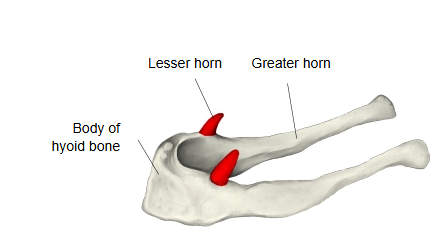
More details
The lesser horn is linked by the stylohyoid ligament to the styloid process of the temporal bone.
Unlike the greater horn, the lesser horn is short and conical and stays partly cartilaginous for a long time. It is joined to the body by fibrous (connective) tissue or by a small synovial joint, which may stay movable until late in life, and it may later fuse with the greater horn; sources differ on how long it stays movable. The stylohyoid ligament may be partly ossified, so that the lesser horn seems to extend upwards into it; rarely the bony bar reaches as far as the styloid process. The chondroglossus arises from its base and the nearby body.
Reference websites
[Wikipedia]
· Hyoid bone, Wikipedia.
· Stylohyoid ligament, Wikipedia.
[Websites with illustrations]
· Hyoid bone (Kenhub)
· Hyoid bone (Radiopaedia)
Where it is found
Related terms
References and sources
- Further reading: Hyoid bone, Wikipedia.
- Further reading: Stylohyoid ligament, Wikipedia.
- Federative International Programme for Anatomical Terminology (FIPAT). Terminologia Anatomica, 2nd ed. (TA2), 2019.