Overview
- The receptor cells for smell: bipolar neurons in the olfactory epithelium.
- Several million on each side; each expresses one type of odorant receptor (humans have about 400 functional types).
- They are the only neurons whose cell bodies lie in a surface epithelium, and they are replaced from basal cells every few weeks.
Olfactory epithelium and olfactory bulb
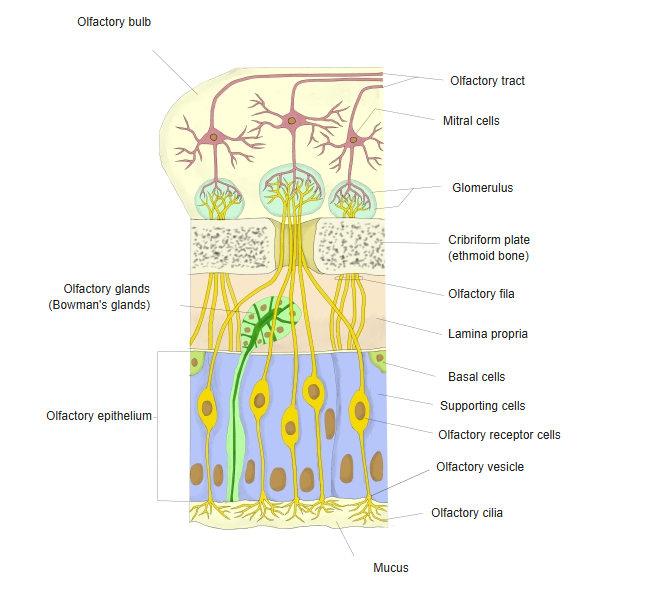
Structure
- Dendrite: a single process to the surface, ending in a knob (olfactory vesicle).
- Olfactory cilia: long, non-motile cilia spreading in the mucus; they carry the odorant receptors.
- Axon: thin and unmyelinated; axons gather into the olfactory fila, which together form the olfactory nerve.
- Axons with the same receptor type converge on the same glomeruli of the olfactory bulb.
Course of the fibers
- The fila pass through the cribriform plate of the ethmoid bone and end in the olfactory bulb.
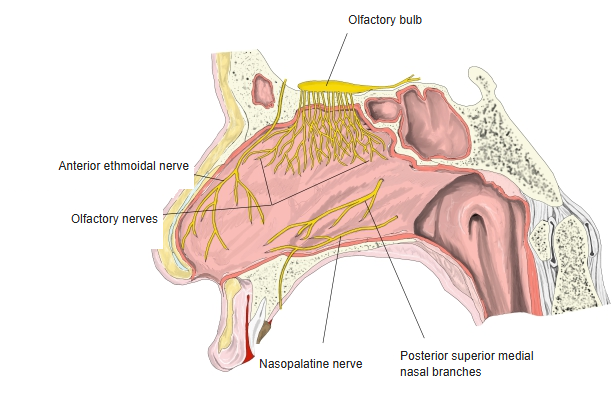
- Other nerves of the nasal mucosa (anterior ethmoidal, nasopalatine and posterior nasal branches) carry general sensation, not smell.
Nerves of the lateral nasal wall
References and sources
- Further reading: Olfactory receptor cells, Wikipedia.