Latin: organum olfactorium
Overview
- The organ of smell: the olfactory part of the mucosa in the roof of the nasal cavity.
- A small yellowish area (a few cm² on each side) on the roof, the upper nasal septum and the superior nasal concha.
- Its receptor cells send their axons through the cribriform plate of the ethmoid bone as the olfactory nerve (CN I) to the olfactory bulb.
- The rest of the nasal mucosa (respiratory part) warms and moistens the air; it is covered on the nasal cavity page.
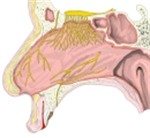
Nerves of the lateral nasal wall 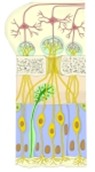
Olfactory epithelium and olfactory bulb
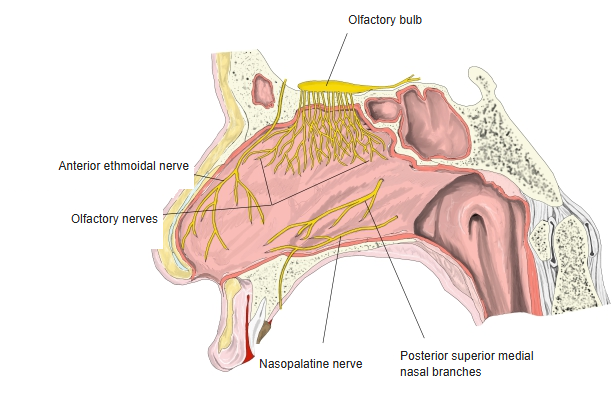
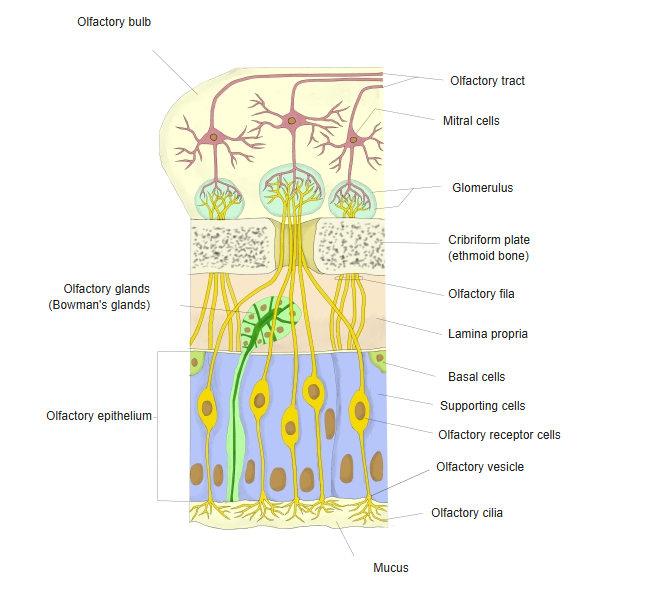
Parts of the olfactory organ
Two parts of the nasal mucosa
| Part | Location | Features |
|---|---|---|
| Respiratory part | Most of the nasal cavity | Ciliated columnar epithelium with goblet cells; rich venous plexuses give it a red colour |
| Olfactory part (olfactory epithelium) | Roof of the cavity, upper septum and superior concha | Yellowish; contains the olfactory receptor cells and the olfactory (Bowman) glands |
- Odorant molecules must dissolve in the mucus over the olfactory epithelium before they can reach the receptors.
- Sniffing directs air upward to the olfactory area, which ordinary quiet breathing reaches only partly.
Olfactory pathway
- Olfactory receptor cells → olfactory fila (together the olfactory nerve) → cribriform plate → olfactory bulb.
- In the bulb the axons synapse in the glomeruli with mitral and tufted cells.
- The olfactory tract carries the signals to the olfactory cortex on the base of the brain, without a relay in the thalamus.
- Injury of the fila at the cribriform plate (for example in head trauma) can cause loss of smell (anosmia).
References and sources
- Further reading: Olfactory organ, Wikipedia.