Dental arch (Latin: arcus dentalis)
Also called the dental arcade
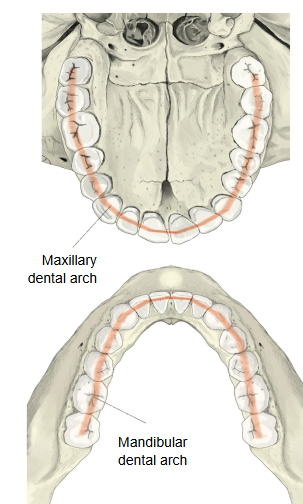
The dental arch is the horseshoe-shaped row of teeth in each jaw, formed by the anterior teeth and the posterior teeth together.
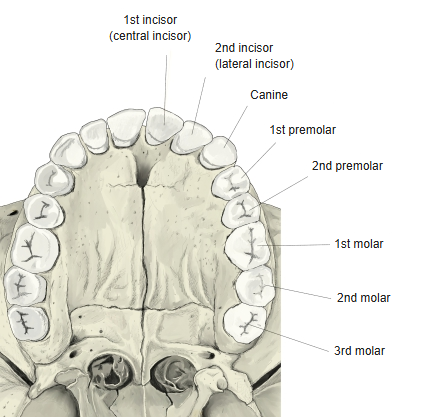
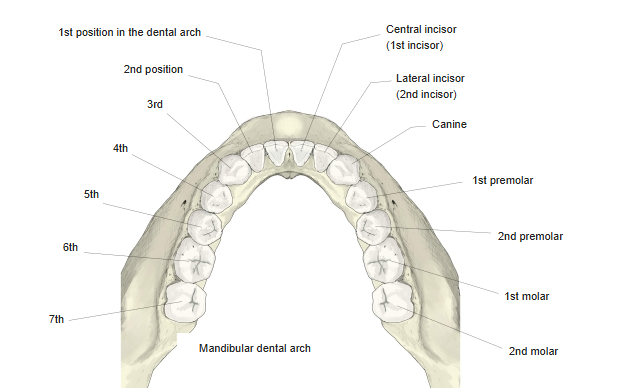
The arch of the maxilla is the upper (maxillary) dental arch, that of the mandible the lower (mandibular) dental arch; counting the third molars, each arch has 16 teeth.
Third molar = wisdom toothDeciduous teeth: 10 in each arch
· Deciduous teeth: upper arch 10 + lower arch 10 = 20 in all.
· Permanent teeth: upper arch 16 + lower arch 16 = 32 in all (counting the third molars).
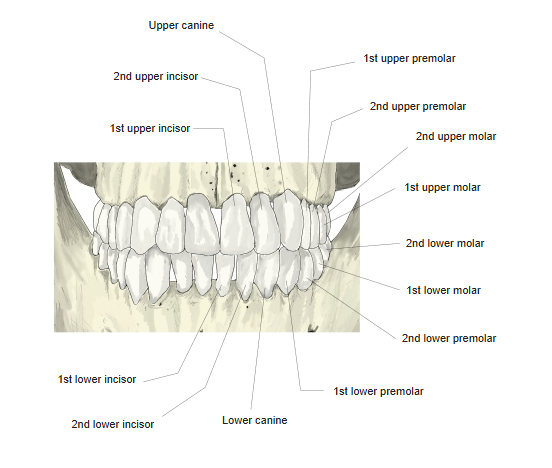
The teeth sit in the sockets of the alveolar processes. From the midline backwards each half of an arch has 2 incisors, 1 canine, 2 premolars and 3 molars. The arch is roughly U-shaped (parabolic), though its exact shape varies between people. The maxillary arch is a little wider than the mandibular arch, so in a normal bite the upper teeth overlap the lower teeth on the outside. The tooth types are described on the Teeth page.
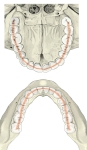 Maxillary and mandibular dental arches
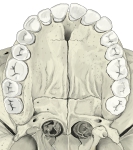 Maxillary dental arch
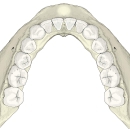 Mandibular dental arch
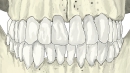 Upper and lower teeth (front view)
Where it is found
Related terms
References and sources
- Further reading: Dental arch, Wikipedia.
- Further reading: Dentition, Wikipedia.
- Federative International Programme for Anatomical Terminology (FIPAT). Terminologia Anatomica, 2nd ed. (TA2), 2019.