Anococcygeal body (Latin: corpus anococcygeum)
Also called Anococcygeal raphe or the anococcygeal ligament
· Also called the anococcygeal ligament.
· Besides "raphe" and "ligament", the name "anococcygeal body" is also used. Sources differ: some use all three names for the same structure; others keep "anococcygeal raphe" for the midline seam of the levator ani on its upper (pelvic) surface, and "anococcygeal body" or "ligament" for the thicker tissue below it.
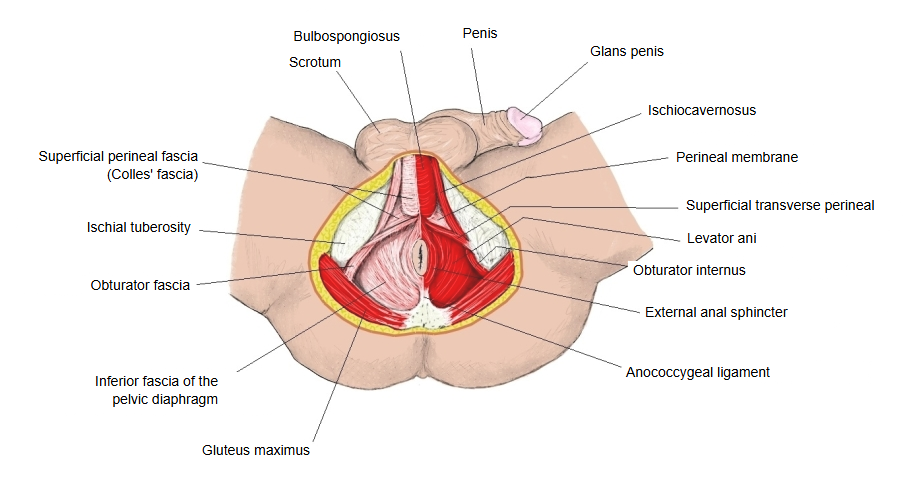
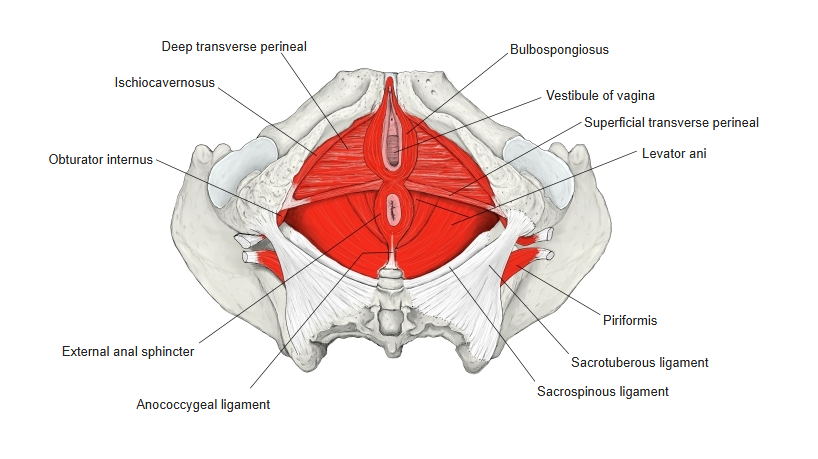
It is a band of fibrous and muscular tissue in the midline of the pelvic floor, in the anal triangle between the anus and the coccyx. It forms where the fibres of the left and right levator ani (mainly pubococcygeus and iliococcygeus) meet behind the anal canal, together with fibres of the external anal sphincter, whose superficial part is anchored to it. It supports the anorectal junction from behind and helps to hold the pelvic floor in shape. The skin over it is supplied by the anococcygeal nerves. In front of it, the gap between the left and right levator ani is the levator hiatus.
 Levator ani (superior view)
 Male perineum
 Female pelvic floor (inferior view)
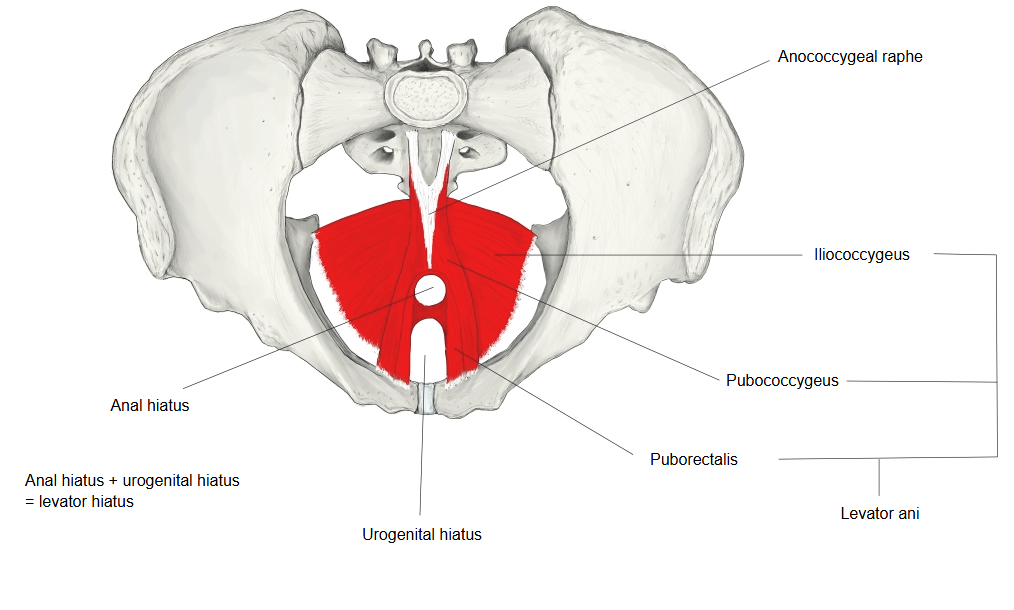
Reference websites
[Wikipedia]
· Anococcygeal body, Wikipedia.
· Levator ani, Wikipedia.
[Websites with illustrations]
· Female pelvic floor from above, with the anococcygeal raphe (Springer)

· Levator ani with the recto-vaginal and ano-coccygeal raphes (Springer)

Related terms
References and sources
- Further reading: Anococcygeal body, Wikipedia.
- Further reading: Levator ani, Wikipedia.
- Federative International Programme for Anatomical Terminology (FIPAT). Terminologia Anatomica, 2nd ed. (TA2), 2019.