Organelle (Latin: organellum)
Also called Cell organelle
= Cell organelle (another name for the same structure)
· A cell consists of the plasma membrane, the cytoplasm and the nucleus. The cytoplasm contains the cytosol, the cytoskeleton and all the organelles except the nucleus; the nucleus is itself the largest membrane-bound organelle, but it is not counted as part of the cytoplasm. Organelles divide the cell into compartments, so that different chemical processes can run side by side.
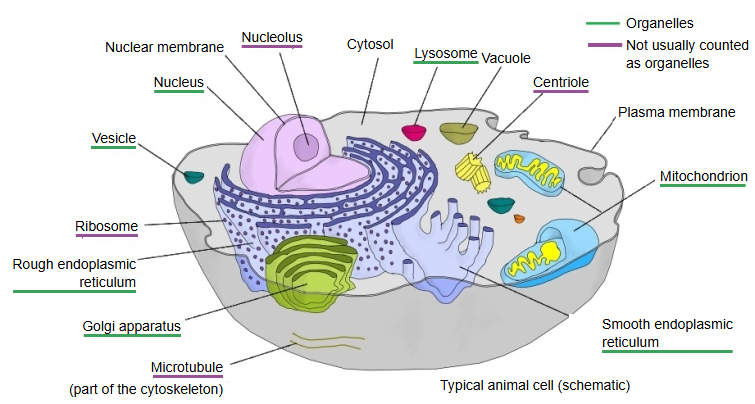
· Membrane-bound organelles: the nucleus (enclosed by a double membrane, the nuclear envelope; stores DNA and controls transcription), mitochondria (produce ATP), the rough endoplasmic reticulum (makes proteins for secretion and for membranes), the smooth endoplasmic reticulum (lipid synthesis, calcium storage and detoxification), the Golgi apparatus (modifies, sorts and ships proteins), lysosomes (break down and recycle material), peroxisomes (oxidative reactions and fatty acid breakdown), endosomes (sort material taken in by endocytosis) and vesicles (carry substances within the cell and release them from it).
· Not usually counted: ribosomes (protein synthesis), the cytoskeleton of microtubules, actin filaments and intermediate filaments (keeps the cell's shape and moves material), centrioles (organize the spindle in cell division) and the nucleolus (makes ribosomal RNA and assembles ribosomes) have specific jobs but no surrounding membrane. Some texts use the word organelle more widely; sources differ.
Related terms
References and sources
- Further reading: Organelle, Wikipedia.
- Federative International Programme for Anatomical Terminology (FIPAT). Terminologia Anatomica, 2nd ed. (TA2), 2019.