Interneuron
Also called the intermediate neuron or the association neuron or the relay neuron
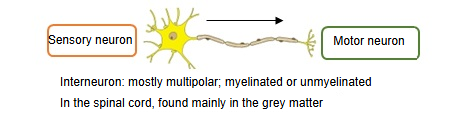
· As a rule, interneurons are not part of the peripheral nervous system.
· They combine and process the information received from sensory neurons and, where needed, send commands to motor neurons.
Why they matter
1. Adjusting simple reflexes
2. Integrating sensory information
3. Making neural circuits flexible (they also take part in learning and memory)
· They are part of most reflex arcs, for example the withdrawal reflex. The simple knee-jerk reflex of the patellar tendon is an exception: its main pathway runs directly from the sensory to the motor neuron, and interneurons only relax the opposing muscles.
· Most are multipolar neurons, with either myelinated or unmyelinated axons.
Examples: inhibitory interneurons (such as Renshaw cells, which damp the activity of motor neurons) and excitatory interneurons.
Myelinated: found in circuits that need relatively fast conduction (for example parts of reflex arcs).
Unmyelinated: common where conduction speed matters less, or in local circuits that integrate information.
· In the spinal cord they lie mainly in the gray matter (posterior, anterior and lateral horns).
· Many interneurons in the spinal cord and brain have relatively short axons, unmyelinated or thinly myelinated.
· They are by far the most numerous type of neuron and form the local circuits that integrate information.
Related terms
References and sources
- Further reading: Interneuron, Wikipedia.
- Federative International Programme for Anatomical Terminology (FIPAT). Terminologia Anatomica, 2nd ed. (TA2), 2019.