Vacuole (Latin: vacuolum)
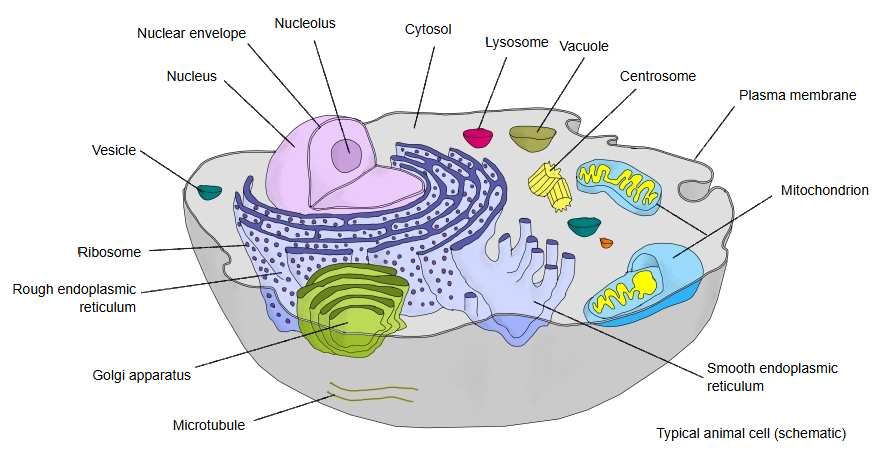
A vacuole is one of the organelles inside a cell: a membrane-bound, fluid-filled space in the cytoplasm used for storage and for breaking down unwanted material. It is large in plant cells but very small in animal cells, including human cells.
More details
In mature plant cells one large central vacuole can fill most of the cell; young plant cells have several small vacuoles, which merge and grow as the cell grows. In animal cells vacuoles are small and variable, and many of their tasks are taken over by lysosomes, endosomes and vesicles. Whether small animal vacuoles form a separate class of organelle is treated differently in different texts.
Parts
| 1 | Tonoplast (vacuolar membrane) | The single membrane that encloses the vacuole. |
| 2 | Cell sap | The fluid inside the tonoplast: a watery solution of sugars, salts, organic acids and pigments (anthocyanins). The organic acids give fruits such as citrus their sour taste, and the anthocyanins give many flowers and fruits their colour. |
Functions
Storage and breakdown of waste
As a cell grows, its vacuole collects waste products, so the older the cell the larger the vacuole; in a fully grown plant cell the vacuole fills the centre of the cell.
Control of the cell's osmotic pressure
The water pressure of the solution in the vacuole (turgor) presses the cytoplasm against the cell wall and keeps the cell firm.
Related terms
References and sources
- Further reading: Vacuole, Wikipedia.
- Federative International Programme for Anatomical Terminology (FIPAT). Terminologia Anatomica, 2nd ed. (TA2), 2019.