Latin: musculus pronator quadratus
Overview
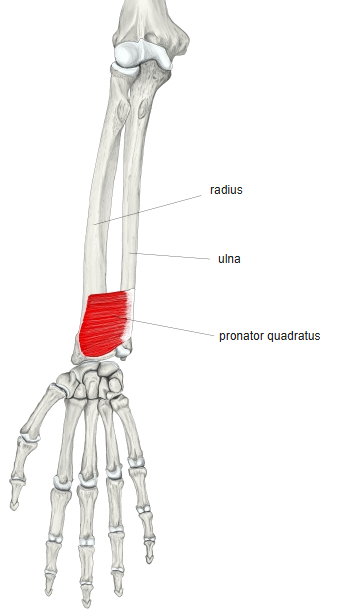
- A square muscle deep in the lower forearm, its fibres running across the forearm.
- The only muscle attached only to the ulna at one end and only to the radius at the other (Wikipedia).
- Its deep fibres help to hold the radius and ulna together (Wikipedia).
Position in the classification
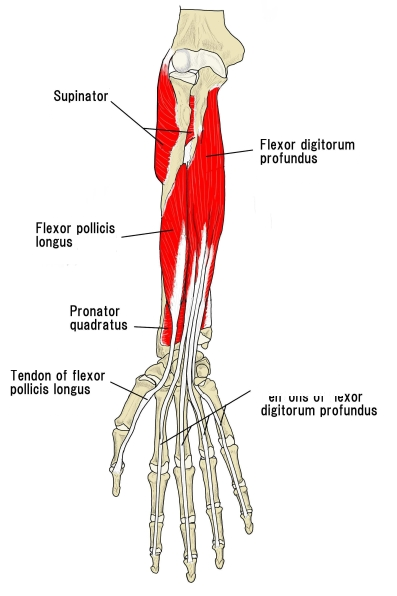
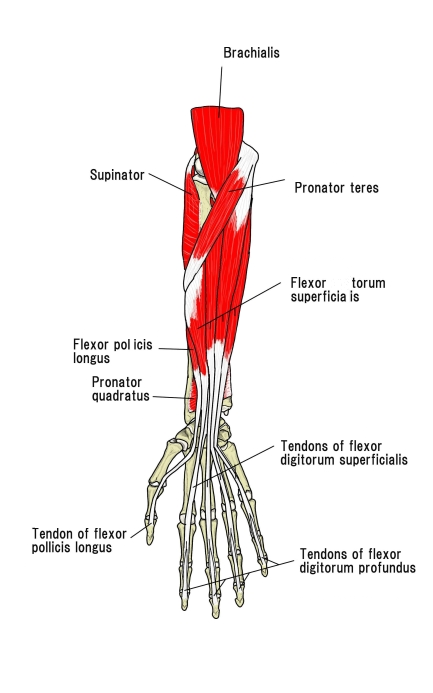
Upper Limb › Forearm › Flexor group › Fourth layer
- Pronator quadratus
Illustrations
Origin / insertion
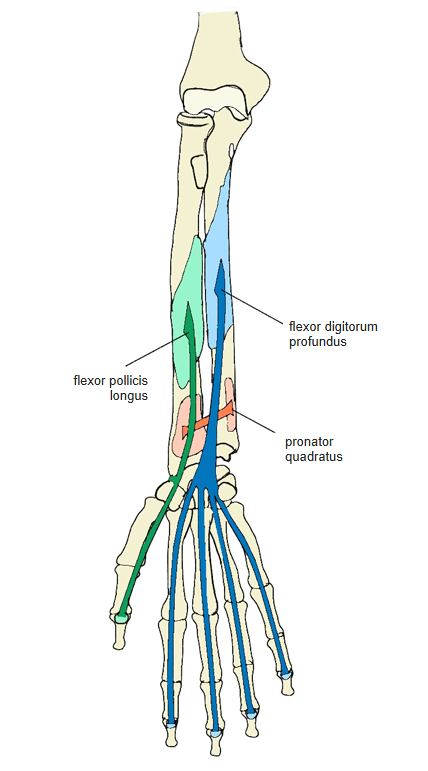
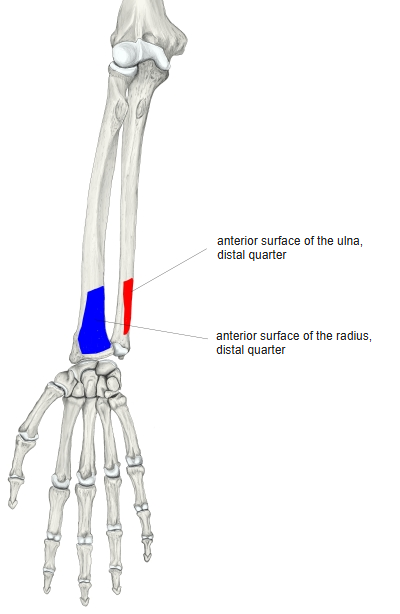
- Origin: anterior surface of the ulna, lower quarter (some sources: reaching round onto the medial surface)
- Insertion: anterior surface of the radius, lower quarter
Action
- Pronates the forearm
Innervation
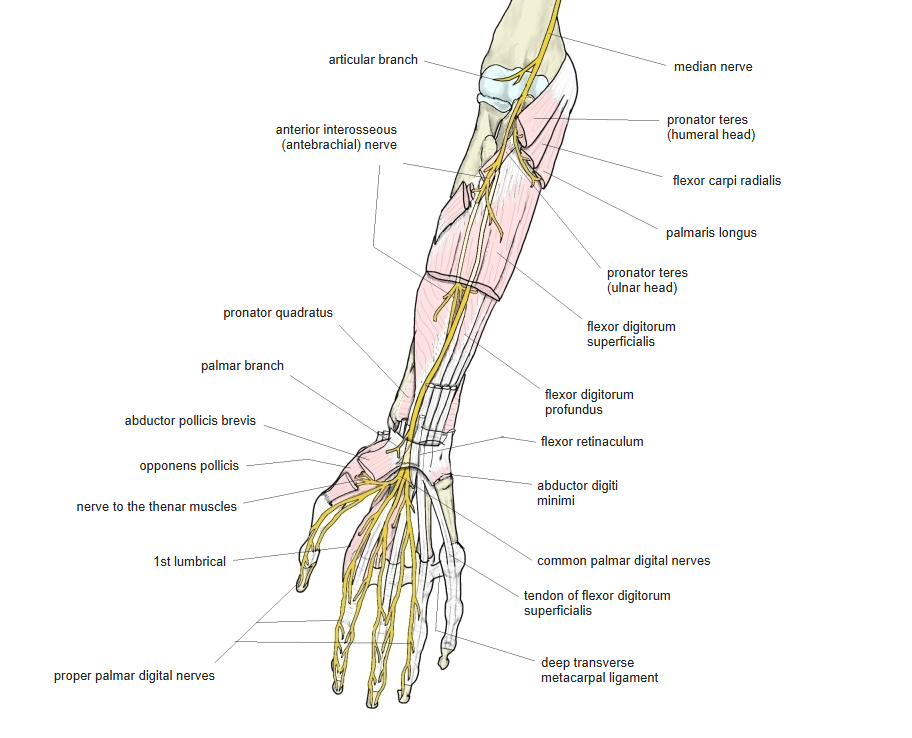
- Anterior interosseous nerve, a branch of the median nerve (C7–T1; sometimes C6)
Blood supply
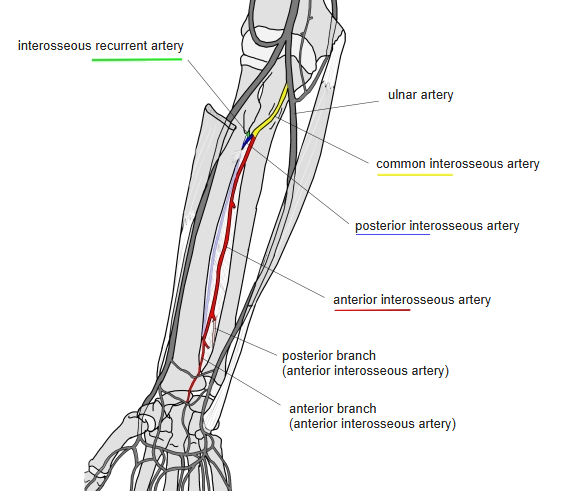
- Anterior interosseous artery
Anatomical variations
- Very rarely absent; may be very narrow or so wide it reaches the middle of the forearm; often triangular or made of two triangular parts; rarely sends a tendon to the carpal bones (Rauber-Kopsch)
Related terms
- Pronator teres
- Flexor pollicis longus
- Flexor digitorum profundus
- Radius
- Ulna
- Anterior interosseous nerve
References and sources
- Further reading: Pronator quadratus muscle, Wikipedia.