Arrector pili muscle (Latin: musculus arrector pili)
Also called the hair erector muscle
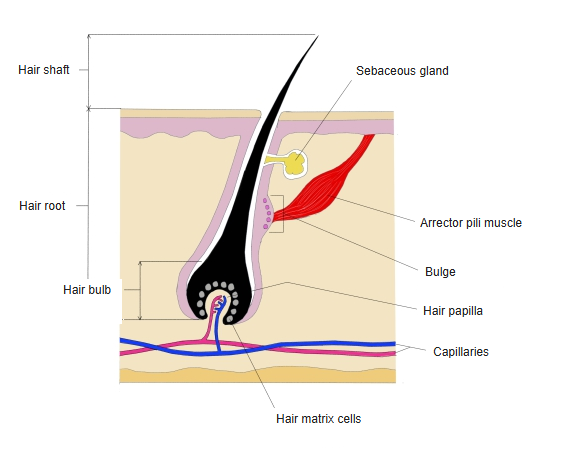
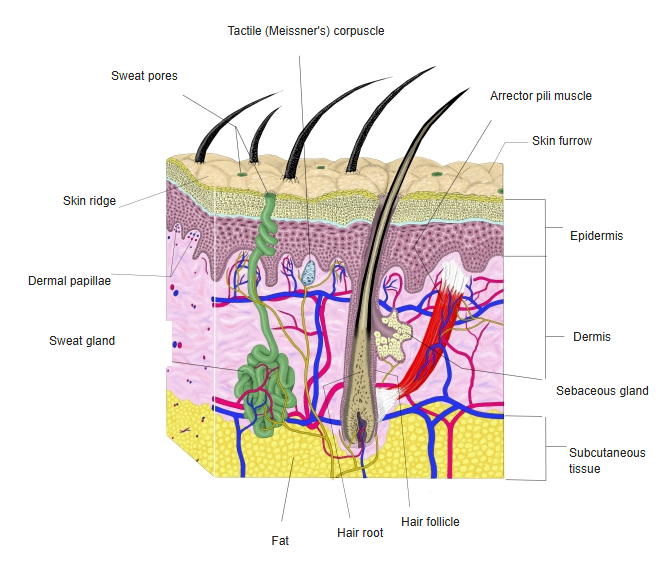
The arrector pili muscle is supplied by adrenergic sympathetic nerve fibres, so it is not under voluntary control. 'Goose bumps' (goose flesh) are produced when it contracts: the hair stands upright and the skin around the hair opening is raised. It contracts with cold and with emotional stress such as fear or surprise, and sometimes also when body temperature is rising. It is attached to the follicle at the bulge, below the sebaceous gland, on the side towards which the hair slopes, and its contraction may help to squeeze sebum out of the gland.
of a hair
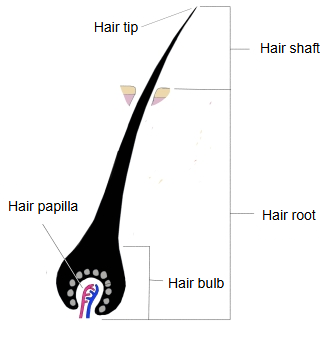
- Hair shaft : the part that projects from the skin
- Hair tip : the thin, pointed free end
- Hair root : the part embedded in the skin
- Hair bulb : the swollen, rounded lowest part
- Hair papilla : the egg- or pear-shaped part that pushes up into the hair bulb from below
- Hair bulb : the swollen, rounded lowest part
- Accessory structures : sebaceous gland, arrector pili muscle, etc.
 Structures around the hair
 Epidermis
Reference websites
[Wikipedia]
· Arrector pili muscle, Wikipedia.
[Websites with illustrations]
· Hair follicle: anatomy and function (Kenhub)
· The skin: layers and appendages (TeachMeAnatomy)
· Diagram of the skin with its appendages (Wikimedia Commons)

Related terms
References and sources
- Further reading: Arrector pili muscle, Wikipedia.
- Federative International Programme for Anatomical Terminology (FIPAT). Terminologia Anatomica, 2nd ed. (TA2), 2019.