Docosahexaenoic acid
Also called DHA
- Overview
- Functions
- Occurrence in foods
- List of n-3 fatty acids
- Reference websites
- (Wikipedia)
- Related terms
Overview
acids
- Saturated fatty acids : no carbon–carbon double or triple bonds; abundant in animal fats.
- Unsaturated fatty acids : one or more carbon–carbon double bonds.
- Monounsaturated : one double bond; typical example oleic acid.
- Polyunsaturated : two or more double bonds.
- n-3 fatty acids : alpha-linolenic acid●, stearidonic acid, eicosatetraenoic acid, EPA, DPA, DHA and others.
- n-6 fatty acids : linoleic acid●, gamma-linolenic acid, dihomo-gamma-linolenic acid, arachidonic acid, docosatetraenoic acid and others.
· It is a slightly yellowish, oily substance.
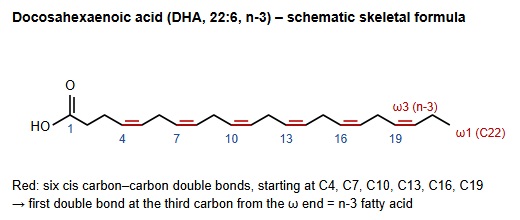
· The name means any carboxylic acid with a chain of 22 carbon atoms and six double bonds (22:6), but usually the all-cis-4,7,10,13,16,19 form, an n-3 fatty acid, is meant. It is abbreviated DHA.
· Together with EPA and DPA it is one of the highly unsaturated fatty acids of fish oils.
· In the body it is unevenly distributed: there is little in the blood and adipose tissue, but much in the grey matter of the brain, the retina, the heart, sperm and breast milk.
n-3 fatty acids in the body
Only a small part of the alpha-linolenic acid taken in is converted to EPA and DHA. EPA is also the starting material of the series-3 prostaglandins and thromboxanes and the series-5 leukotrienes.
Functions
DHA is a major fatty acid of the membrane phospholipids of the brain and of the photoreceptor cells of the retina.
Each cis double bond bends the chain, so phospholipids containing DHA pack loosely and keep the membrane fluid. Membrane fluidity affects the movement of membrane proteins such as receptors and ion channels.
Occurrence in foods
It is found in fish and other seafood; the fat around the eyes of fish is especially rich in it.
List of n-3 fatty acids
Examples of n-3 fatty acids (not a complete list).
| Name | Notes | ||
|---|---|---|---|
| n-3 | 1 | Alpha-linolenic acid (ALA) ● | found in many plant oils; an essential fatty acid. |
| 2 | Stearidonic acid (SDA) | made from alpha-linolenic acid; found in some seed oils. | |
| 3 | Eicosatrienoic acid (ETE) | ||
| 4 | Eicosatetraenoic acid (ETA) | ||
| 5 | Eicosapentaenoic acid (EPA) | abundant in fish oils. | |
| 6 | Docosapentaenoic acid (DPA; clupanodonic acid) | ||
| 7 | Docosahexaenoic acid (DHA) | abundant in fish oils; a major fatty acid of the membranes of the brain and the retina. | |
| 8 | Tetracosapentaenoic acid | ||
| 9 | Tetracosahexaenoic acid (nisinic acid) | ||
Reference websites
[Wikipedia]
· Docosahexaenoic acid, Wikipedia.
Related terms
- Omega-3 fatty acids
- Eicosapentaenoic acid
- Docosapentaenoic acid
- Alpha-linolenic acid
- Phospholipids
- Photoreceptor cell
References and sources
- Further reading: Docosahexaenoic acid, Wikipedia.
- Federative International Programme for Anatomical Terminology (FIPAT). Terminologia Anatomica, 2nd ed. (TA2), 2019.