Latin: phalanges distales pedis
Overview
- The most distal of the toe bones; there is one in each toe, five in all, from the 1st (big toe) to the 5th (little toe).
- The proximal end (base) has an articular surface that articulates with the head of the middle phalanx (in the big toe, the proximal phalanx).
- The distal end is expanded and flattened, and bears a rough tuberosity of the distal phalanx, which supports the tip of the toe and the nail.
- Bones of the lower limb (one side)
- Pelvic girdle
- Hip bone ← ilium, ischium and pubis fused
- Free lower limb
- Thigh and knee
- Femur
- Patella
- Leg
- Tibia ← big-toe side
- Fibula ← little-toe side
- Foot
- Tarsal bones (7)
- Metatarsal bones (5)
- Phalanges (14)
- Thigh and knee
- Pelvic girdle
Illustrations
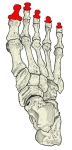
Distal phalanges of the right foot (dorsal)
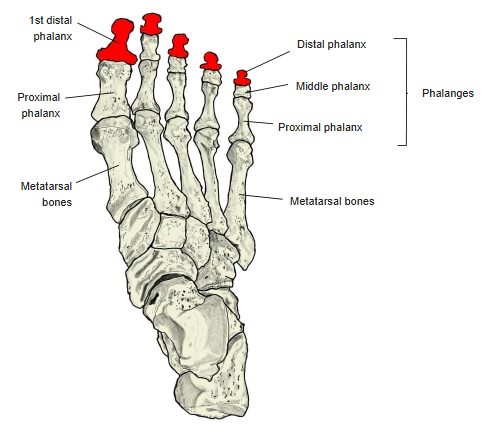
Articulations
| # | Bone | Joint |
|---|---|---|
| 1 | Middle phalanges (big toe: proximal phalanx) | Distal interphalangeal joints (big toe: interphalangeal joint) |
Muscle attachments
- Numbered figures of the muscle attachments on the whole foot: see Metatarsal bones → Muscle attachments.
- Origin of: none
- Insertion of: Flexor digitorum longus, Flexor hallucis longus, Extensor hallucis longus
Flexor digitorum longus inserts on the plantar side of the base of the distal phalanges of the 2nd–5th toes; flexor hallucis longus on that of the big toe. Extensor hallucis longus inserts on the dorsal side of the base of the distal phalanx of the big toe.
References and sources
- Further reading: Phalanx bone, Wikipedia.