Suprascapular notch (Latin: incisura scapulae)
Also called the scapular notch
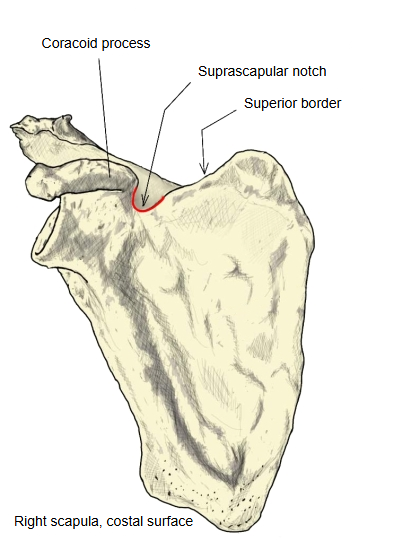
1. Its size and shape vary a great deal between individuals, from a wide shallow dip to a deep narrow cleft.
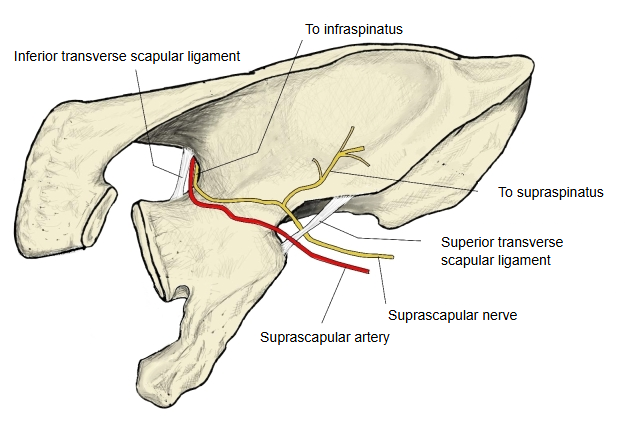
2. It is bridged by the superior transverse scapular ligament, which turns it into a foramen; the suprascapular nerve passes through below the ligament, while the suprascapular artery and vein usually pass above it. A narrow notch is a recognised site of suprascapular nerve entrapment.
3. The superior transverse scapular ligament may ossify; the notch then becomes a bony scapular foramen.
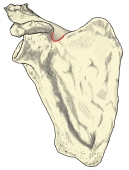 Right scapula (anterior)
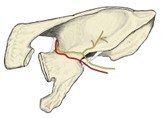 Nerve and artery at the notch
The shape of the notch has been classified into six types (Rengachary and colleagues, 1979):
· Type I: no notch; the superior border forms a wide depression from the superior (medial) angle to the coracoid process.
· Type II: a blunted V-shaped notch occupying the middle third of the superior border.
· Type III: a U-shaped notch with nearly parallel margins.
· Type IV: a very small V-shaped notch; a shallow groove for the suprascapular nerve is often found beside it.
· Type V: a minimal U-shaped notch with a partly ossified ligament.
· Type VI: the ligament is completely ossified, so the notch has become a foramen (scapular foramen).
Reference websites
[Wikipedia]
· Suprascapular notch, Wikipedia.
Where it is found
Related terms
- Superior border of scapula
- Coracoid process
- Scapular foramen
- Supraspinous fossa
- Superior angle of scapula
References and sources
- Further reading: Suprascapular notch, Wikipedia.
- Federative International Programme for Anatomical Terminology (FIPAT). Terminologia Anatomica, 2nd ed. (TA2), 2019.