Latin: Structura vasorum
Overview
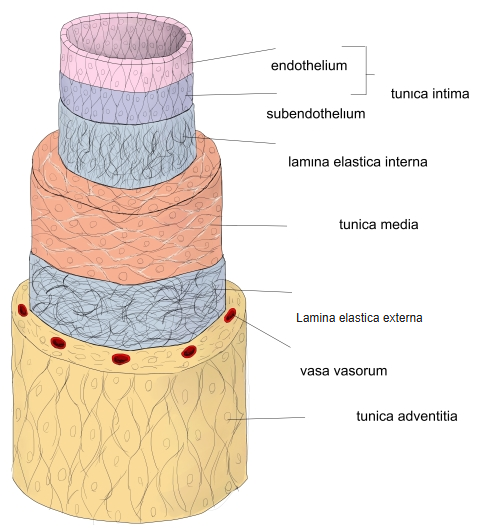
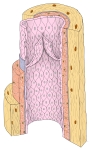
- The wall of arteries and veins has three layers (tunics):
- Tunica intima: endothelium on a thin layer of connective tissue; in arteries an internal elastic membrane marks its outer border.
- Tunica media: smooth muscle and elastic fibres arranged in circles; thickest in arteries.
- Tunica externa (adventitia): connective tissue holding the vessel in place; carries its own small vessels and nerves.
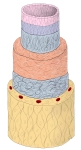
Layers of the arterial wall 
Arteries, capillaries and veins
Arteries
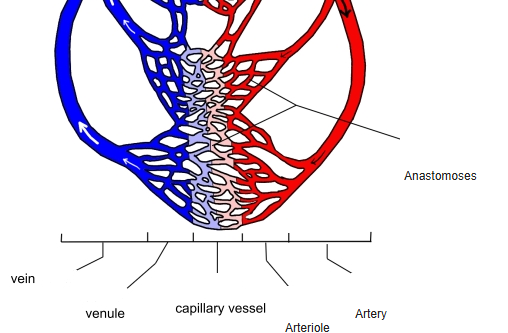
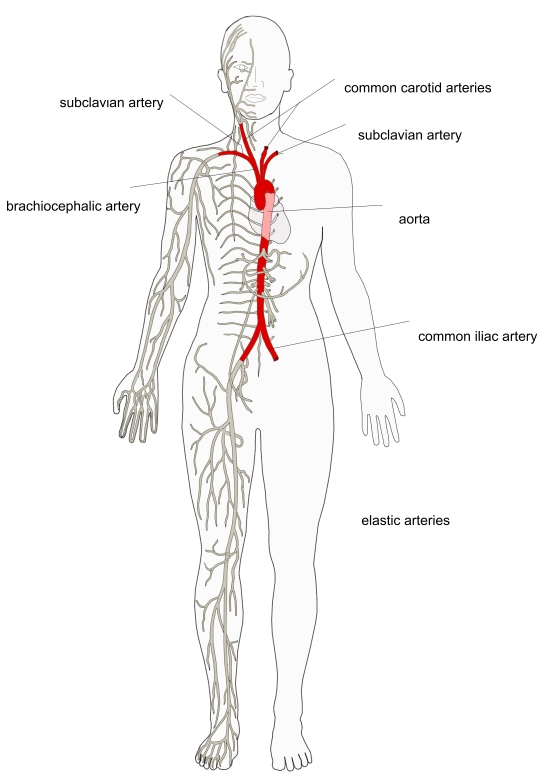
- Elastic arteries (aorta and its large branches): many elastic layers in the media smooth out the pressure from each heartbeat.
- Muscular arteries (most named arteries): a thick muscle layer controls the flow to organs.
- Arterioles: one or two layers of muscle; the main site of resistance to flow.
Main arteries of the body
Capillaries
- A single layer of endothelium on a basement membrane; exchange of gases, nutrients and waste happens here.
- Types: continuous, fenestrated and sinusoidal (discontinuous) capillaries.
Veins
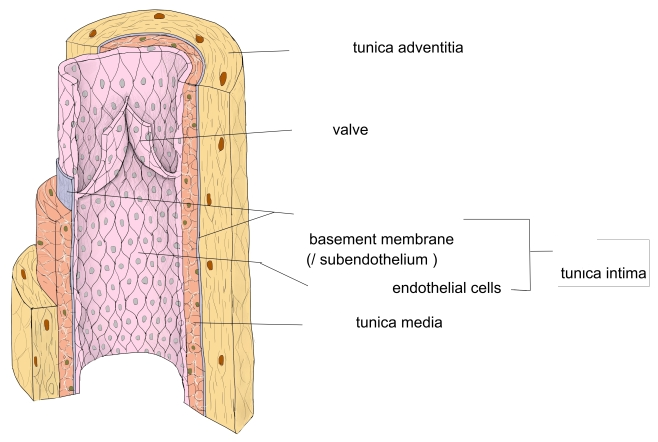
- Thinner walls and wider lumen than the matching arteries; the media is thin and the adventitia is the thickest layer.
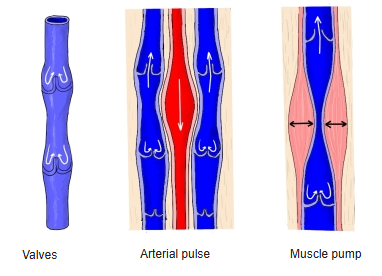
- Most veins of the limbs have valves that keep blood flowing toward the heart.
- They hold most of the blood volume of the body.
Structure of a vein 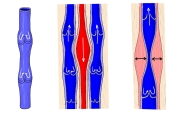
How blood returns in the veins
References and sources
- Further reading: Structure of vessels, Wikipedia.