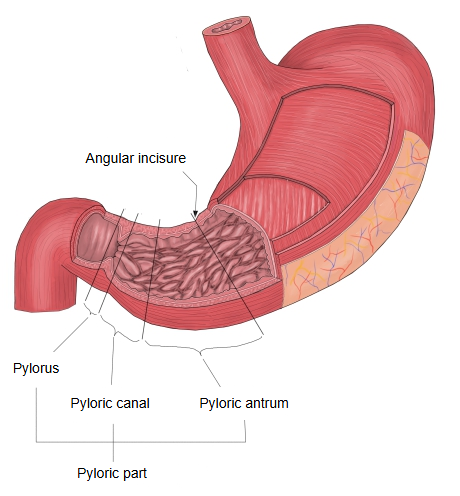
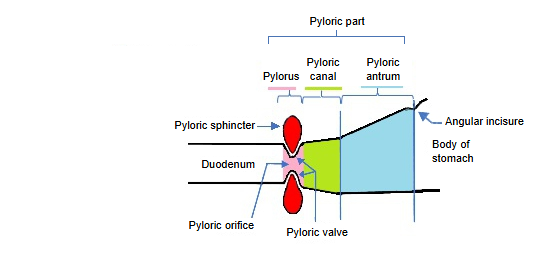
Angular incisure (Latin: incisura angularis)
Also called the angular notch
· On the lesser curvature, where the body and the pyloric part meet, the wall sinks in at a sharp angle; this is the angular incisure. It lies at the lowest part of the lesser curvature, where the curvature turns from running downward to running to the right toward the pylorus.
In more detail:
At the border between the body and the pyloric part, the lesser curvature dips deeply inward to form the angular incisure. Its official name is angular incisure (incisura angularis), but in English texts the name angular notch is more common.
· There is no matching notch on the greater curvature, so the border between the body and the pyloric antrum there is drawn by a line from the angular incisure. Sources differ on exactly where this line runs.
· Its position changes with posture and with how full the stomach is.
· Seen from inside at endoscopy, it forms a ridge called the gastric angle, a standard landmark.
Reference websites
[Wikipedia]
· Angular incisure, Wikipedia.
· Stomach, Wikipedia.
[Websites with illustrations]
· Outline of the stomach with its landmarks (Gray's Anatomy) (Wikimedia Commons)

· Stomach (Kenhub)
· The stomach (TeachMeAnatomy)
Where it is found
Related terms
References and sources
- Further reading: Angular incisure, Wikipedia.
- Further reading: Stomach, Wikipedia.
- Federative International Programme for Anatomical Terminology (FIPAT). Terminologia Anatomica, 2nd ed. (TA2), 2019.