Canine (Latin: dens caninus)
Also called the canine tooth, cuspid or eye tooth
A canine is the pointed tooth at the corner of the mouth, the third tooth from the midline in each half of the dental arch, used for gripping and tearing food. Canines are described with the other tooth types on the Teeth page.
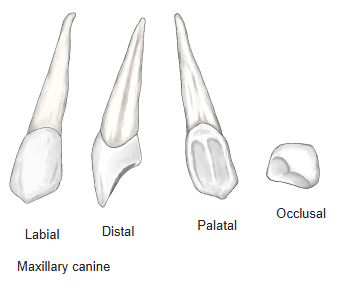
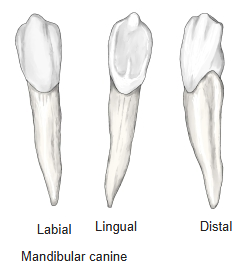
There is one canine in each quarter of the dental arch, between the lateral incisor and the first premolar: 4 in the permanent teeth and 4 in the deciduous teeth. The crown ends in a single strong cusp; as in the incisors, the labial surface is convex and the lingual surface concave. It has a single root, the longest of any tooth, so the maxillary canine is usually the longest tooth in the mouth; the root of the mandibular canine is occasionally split in two. The long root makes a ridge on the front of the maxilla (canine eminence), with the canine fossa lateral to it. Permanent canines erupt at about 9–10 years (mandibular) and 11–12 years (maxillary).
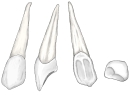 Maxillary canine
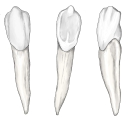 Mandibular canine
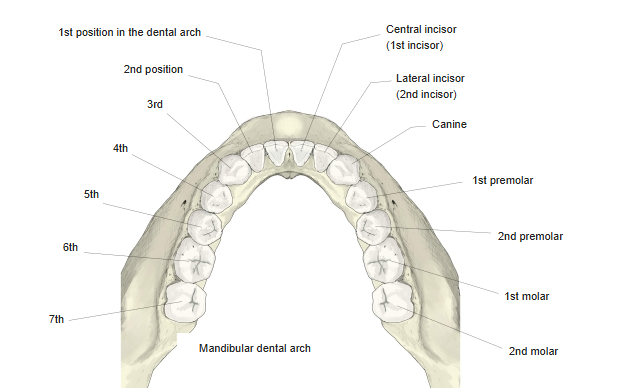
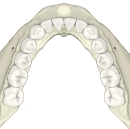 Mandibular dental arch
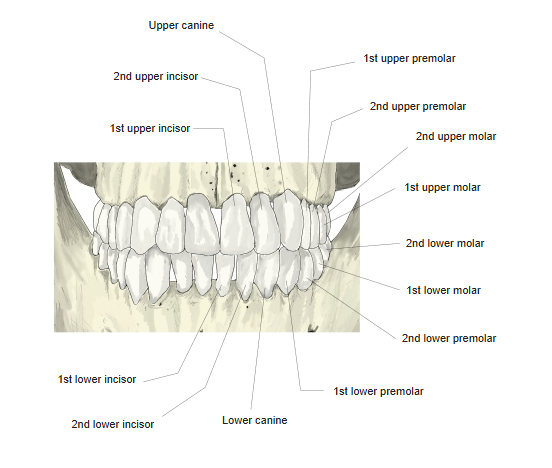
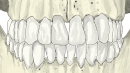 Upper and lower teeth (front)
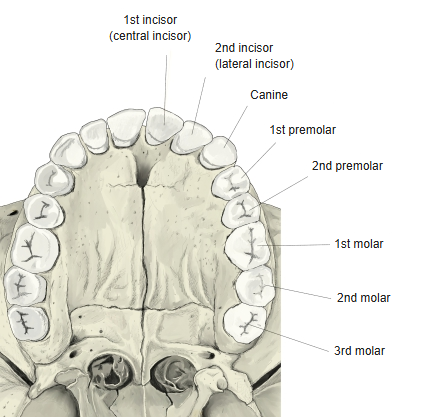
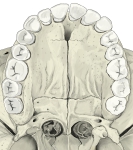 Maxillary dental arch
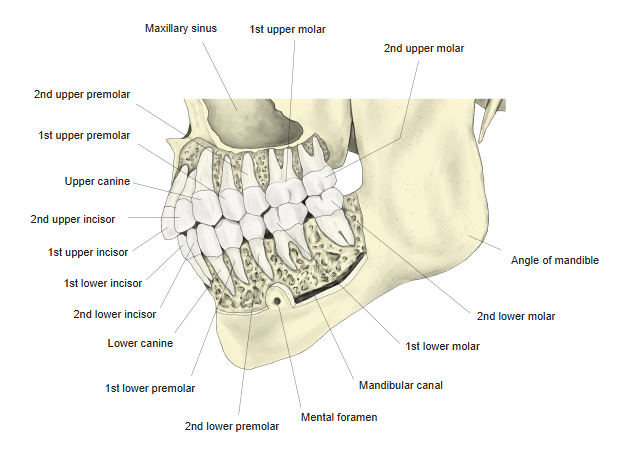
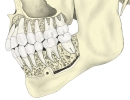 Teeth and alveolar bone
Related terms
References and sources
- Further reading: Canine tooth, Wikipedia.
- Federative International Programme for Anatomical Terminology (FIPAT). Terminologia Anatomica, 2nd ed. (TA2), 2019.