Carabelli's tubercle (Latin: tuberculum anomale)
Also called the cusp of Carabelli or Carabelli's cusp or Carabelli trait
· It is named after Georg Carabelli (1787-1842), a Hungarian-born dentist at the imperial court in Vienna, who described it in 1842.
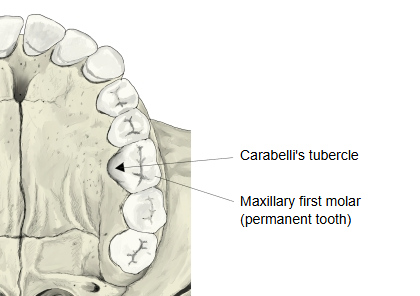
It is a variable, inherited trait. It becomes smaller and less frequent from the first to the second and third molars, and ranges from complete absence, or only a groove, pit or ridge, to a distinct cusp almost as large as the distolingual cusp. Small forms consist of enamel only; a large cusp may contain dentin, but it has no root of its own.
Its frequency also differs between populations.
Reported figures vary from study to study: one often-quoted study found it in about half of European Americans, about a third of African Americans and 5-20% of Native Americans. Sources differ.
Figures for other populations, including East Asian ones, also vary widely between studies.
Reference websites
[Wikipedia]
· Cusp of Carabelli, Wikipedia.
· Maxillary first molar, Wikipedia.
[Websites with illustrations]
· Cusp of Carabelli (supernumeraryteeth.com)

· Carabelli's trait (figure) (Science and Education Publishing)

Related terms
References and sources
- Further reading: Cusp of Carabelli, Wikipedia.
- Further reading: Maxillary first molar, Wikipedia.
- Federative International Programme for Anatomical Terminology (FIPAT). Terminologia Anatomica, 2nd ed. (TA2), 2019.