Gastric pits (Latin: foveolae gastricae)
Also called the gastric foveolae
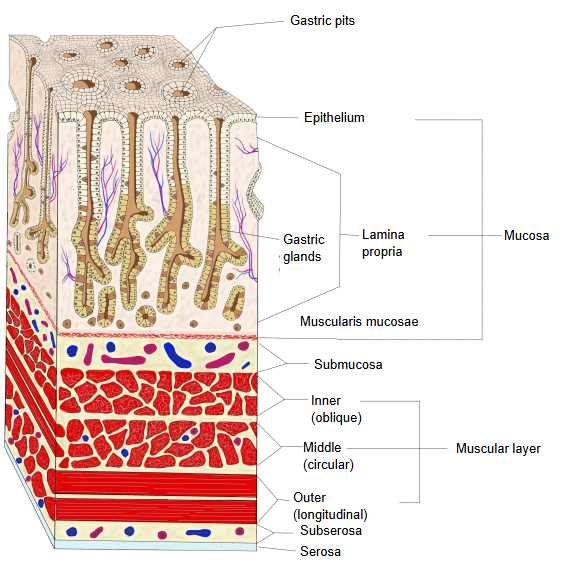
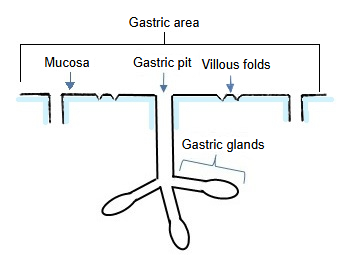
· Usually three or four (proper) gastric glands open into the base of each pit; sources differ on the exact number.
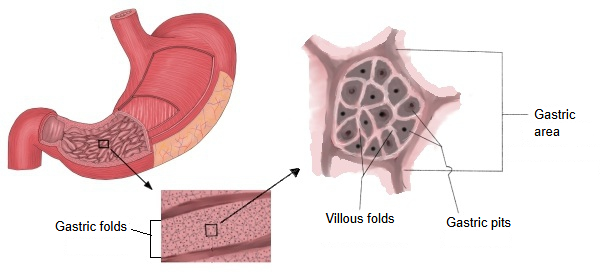
· Groups of gastric pits are separated by shallow grooves into small polygonal fields, the gastric areas.
· The inner surface of the stomach is covered with millions of these pits, giving it a finely perforated look under a lens.
· They are lined by the same mucus-secreting columnar epithelium as the surface; the mucus helps protect the mucosa from acid.
· The pits are shallow in the fundus and body, where the glands are long, and deeper in the pyloric part.
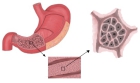 Gastric areas and pits
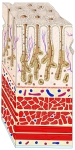 Layers of the stomach wall
 Mucosa in section (diagram)
Reference websites
[Wikipedia]
· Gastric pits, Wikipedia.
· Gastric glands, Wikipedia.
[Websites with illustrations]
· Stomach histology: mucosa, glands and layers (Kenhub)
· Layers of the stomach wall, with gastric pits and areas (Wikimedia Commons)

Where it is found
Related terms
References and sources
- Further reading: Gastric pits, Wikipedia.
- Further reading: Gastric glands, Wikipedia.
- Federative International Programme for Anatomical Terminology (FIPAT). Terminologia Anatomica, 2nd ed. (TA2), 2019.