Longitudinal diameter (pelvis)
Also called the anteroposterior diameter of the pelvic outlet
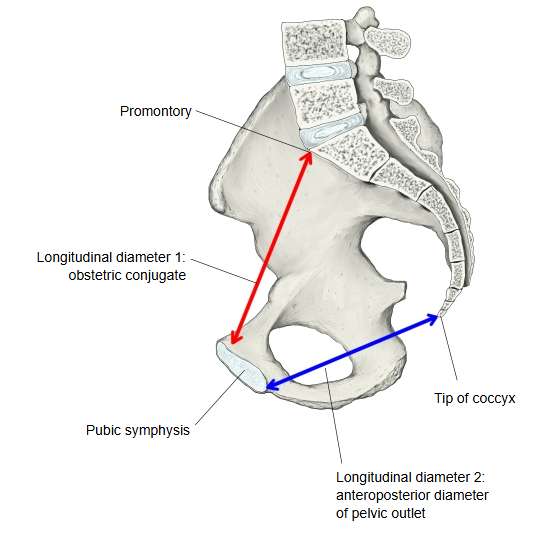
Sources differ in how they explain the longitudinal diameter: some use it only for the pelvic outlet, others count a second diameter at the pelvic inlet as well. The front-to-back diameters as a group are usually called median diameters.
Narrow sense: diameter of the pelvic outlet
Among the measurements of the pelvic outlet, the longitudinal diameter is a front-to-back measurement of the lesser pelvis in the median plane.
It is the distance from the lower border of the pubic symphysis to the tip of the coccyx, roughly 9.5 to 11.6 cm in adults. The coccyx can move backwards during childbirth, so this diameter can widen a little; some texts therefore measure it to the sacrococcygeal joint instead.
Wider sense: also the obstetric conjugate
Some sources also count the obstetric conjugate, from the sacral promontory to the nearest point on the back of the pubic symphysis, as a longitudinal diameter, this time of the pelvic inlet. It is close to, but not the same as, the anatomical (true) conjugate, which ends at the upper border of the symphysis; in practice it is estimated from the diagonal conjugate.
diameter
- Obstetric conjugate : the shortest distance between the promontory and the pubic symphysis (pelvic inlet). Diameter 1 in the figure.
- Longitudinal diameter of the pelvic outlet : the distance between the tip of the coccyx and the lower border of the pubic symphysis. Diameter 2 in the figure.
Related terms
- Median diameter (pelvis)
- Anatomical conjugate
- Diagonal conjugate
- Pubic symphysis
- Promontory (sacrum)
- Lesser pelvis
- Coccyx
References and sources
- Further reading: Pelvic outlet, Wikipedia.
- Further reading: Pelvimetry, Wikipedia.
- Federative International Programme for Anatomical Terminology (FIPAT). Terminologia Anatomica, 2nd ed. (TA2), 2019.