Plasma cell
Also called the plasmocyte or the effector B cell
Overview
B cells form in the bone marrow and move to the secondary lymphoid organs. A plasma cell is oval, with an eccentric round nucleus whose dark chromatin clumps give a "clock-face" or "cartwheel" look; its basophilic cytoplasm is packed with rough endoplasmic reticulum, and a pale area next to the nucleus marks the Golgi apparatus. Plasma cells are common in the medullary cords of lymph nodes, the red pulp of the spleen, the bone marrow and the lamina propria of the gut and airways. They no longer divide; they spend their whole life making and releasing one kind of antibody.
Short-lived plasma cells
· Naive B cells stimulated by an antigen differentiate directly into plasma cells outside the follicles (in the paracortex and near the follicle margins, the marginal zone).
Because the place where they receive antigen presentation and the place where they differentiate are the same or close together, differentiation is quick (1–3 days).
· Life span: a few days to a few weeks.
· Formation starts: right after the B cell receives antigen presentation from a helper T cell.
· Antibodies: mostly IgM; IgG and IgA may also be made. They make large amounts quickly: the early defence.
· Movement: after forming they hardly move and stay where they are.
Long-lived plasma cells
· Naive B cells stimulated by an antigen move into a follicle, form a germinal centre there (secondary follicle) and differentiate into plasma cells inside it.
They therefore travel farther than short-lived plasma cells, and forming the germinal centre also takes time, so differentiation is slower (1–2 weeks).
· Life span: months to years, sometimes for life.
· Formation starts: antigen presentation ⇒ move into the follicle ⇒ formation of the germinal centre, and only then.
· Antibodies: mainly high-affinity IgG or IgA, with a steady output that gives lasting protection after infection or vaccination.
· Movement: after differentiating in the germinal centre, most leave with the flow of lymph and blood and settle mainly in the bone marrow.
Short- and long-lived plasma cells compared
| Feature | Short-lived plasma cells | Long-lived plasma cells | |
|---|---|---|---|
| 1 | Where formed | Outside the follicles (paracortex, marginal zone) | In the follicles (germinal centres) |
| 2 | Time needed (*) | 1–3 days | 1–2 weeks |
| 3 | Life span | A few days to a few weeks | Months to years, sometimes for life |
| 4 | Formation starts | Right after antigen presentation | After the germinal centre has formed |
| 5 | Destination | Hardly move; stay where they are | Travel with the lymph and blood, mainly to the bone marrow |
| 6 | Role | Early defence | Lasting defence, immune memory |
* Time needed: the time from antigen presentation until the B cell has become a plasma cell.
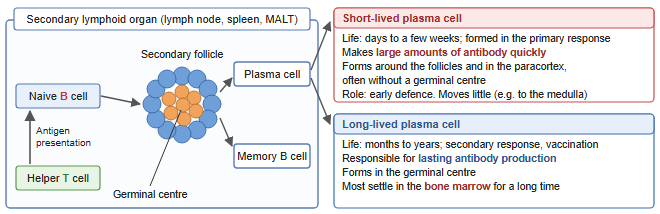
Development of a plasma cell
The naive B cell moves from the bone marrow to the secondary lymphoid organs mainly through the blood.
Related terms
- B lymphocyte
- Germinal center
- Lymph node
- Lymphoid nodule
- Bone marrow
- Spleen
- Primary lymphoid follicle
References and sources
- Further reading: Plasma cell, Wikipedia.
- Federative International Programme for Anatomical Terminology (FIPAT). Terminologia Anatomica, 2nd ed. (TA2), 2019.