Symphyseal surface (Latin: facies symphysialis)
Also spelt symphysial surface (of the pubis).
It is also spelt symphysial surface; in Terminologia Anatomica it is the symphysial surface of the pubis.
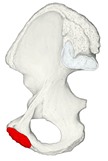 Right hip bone (medial)
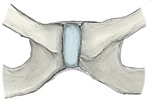 Pubic symphysis (anterior)
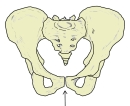 Pelvis (anterior)
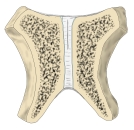 Pubic symphysis (coronal section)
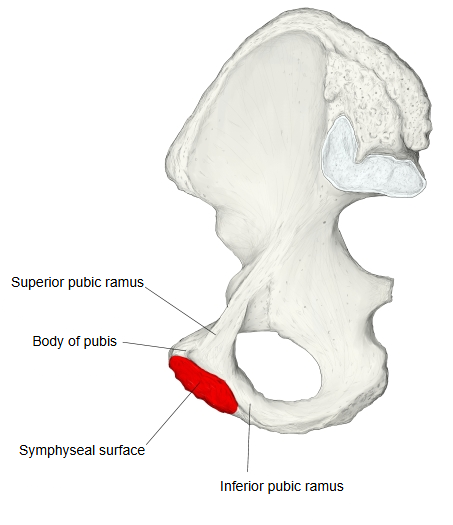
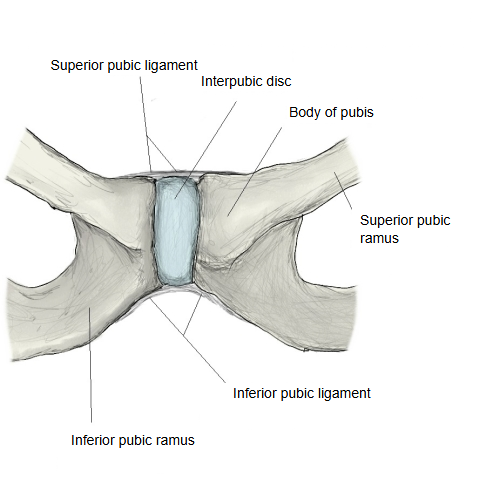
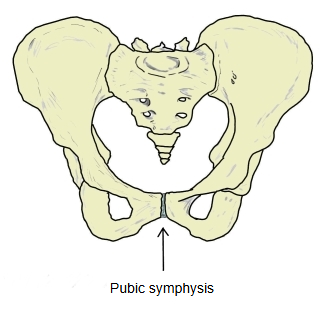
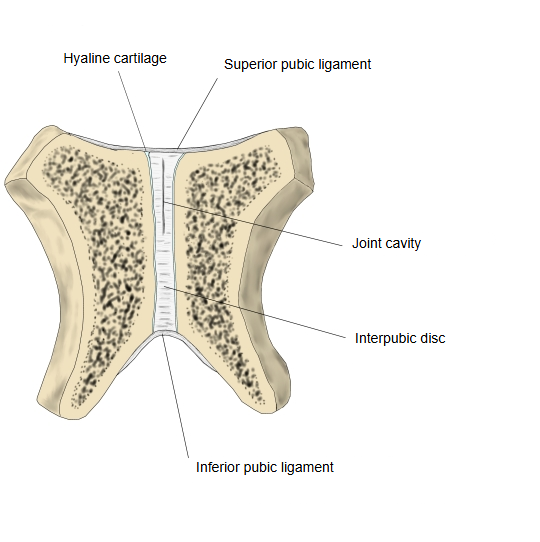
The front and medial end of the body of the pubis is thickened and carries the long, oval, uneven symphyseal surface. Its outline and surface change with age in a regular way, so it is one of the standard features for estimating age at death from the skeleton. T. W. Todd (1920, 1921) described ten phases, and later systems such as Suchey–Brooks are still used in forensic anthropology. In the late teens the whole surface carries several clear transverse ridges and furrows; with age the furrows become shallower and the ridges fade until the surface is flat (in the mid- to late twenties). As the surface ossifies its rim becomes defined, and from about 40 years onwards it becomes rough, porous and irregular.
⇒ Todd's ten age phases of the symphyseal surface (photographs)

Reference websites
[Wikipedia]
· Pubic symphysis, Wikipedia.
[Websites with illustrations]
· Pubis: body, rami and symphyseal surface (Kenhub)
· Pubic symphysis: structure and function (Kenhub)
Related terms
- Pubic symphysis
- Body of pubis
- Interpubic disc
- Hyaline cartilage
- Superior pubic ramus
- Inferior pubic ramus
- Pubic tubercle
References and sources
- Further reading: Pubic symphysis, Wikipedia.
- Federative International Programme for Anatomical Terminology (FIPAT). Terminologia Anatomica, 2nd ed. (TA2), 2019.