Urogenital hiatus (Latin: hiatus urogenitalis)
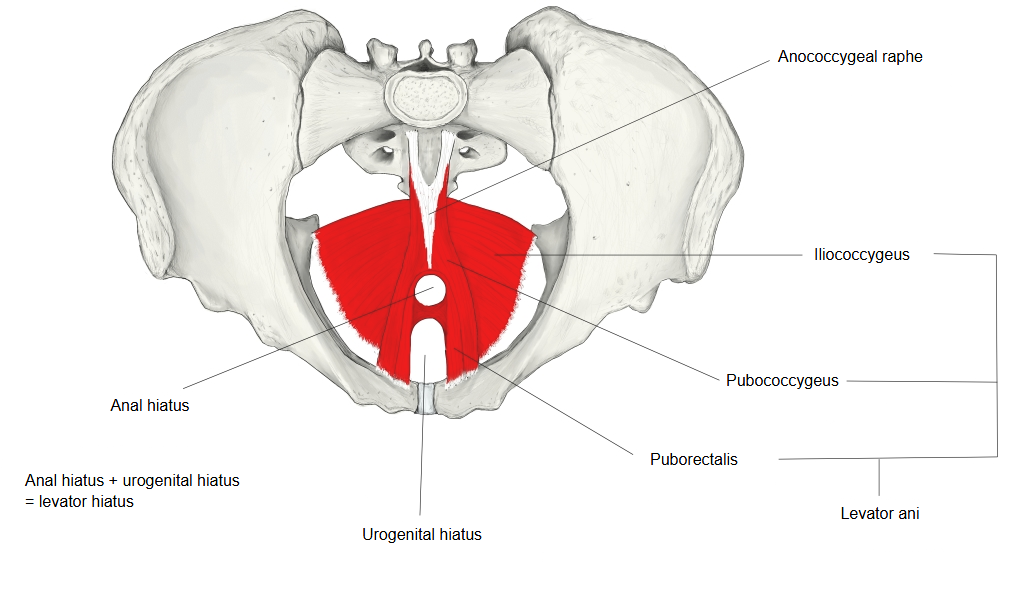
The urogenital hiatus is the gap at the front of the pelvic floor through which the urethra and, in females, the vagina pass; it is one part of the levator hiatus.
Front: just behind the pubic symphysisLevator hiatus: the urogenital hiatus and the anal hiatus together, the gap in the levator ani
Openings
in the
pelvic floor
in the
pelvic floor
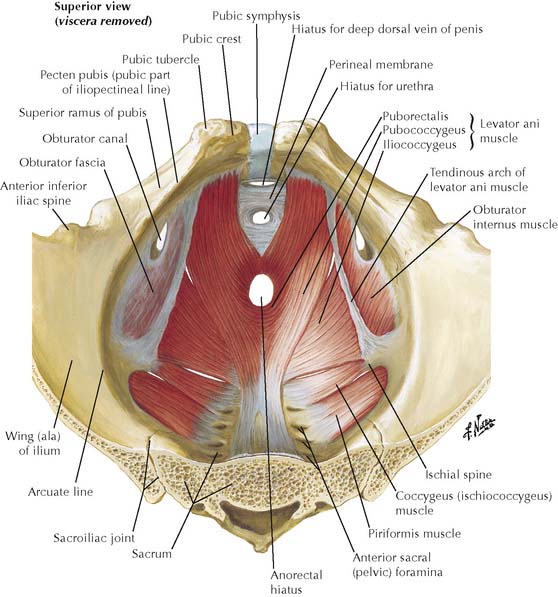
- Subpubic gap : a small gap just below the pubic symphysis, at the very front of the perineal membrane (between it and the arcuate pubic ligament).
Passes: the deep dorsal vein of the penis (male) / of the clitoris (female). - Urogenital hiatus : the V-shaped gap between the right and left puborectalis.
Passes: the urethra and the vagina. - Anal hiatus : the opening at the back of the pelvic floor, just in front of the place where the right and left levator ani meet.
Passes: the anal canal.
Reference websites
[Wikipedia]
· Urogenital hiatus, Wikipedia.
[Websites with illustrations]


Function
The hiatus lets the urethra and the vagina pass through the pelvic floor muscles (pelvic diaphragm). Below, the opening is closed by the perineal membrane and the deep perineal muscles.
Clinical significance
A widened hiatus, for example after childbirth, is linked with stress urinary incontinence and pelvic organ prolapse. Sources differ in usage: some use 'urogenital hiatus' for the whole gap between the levator ani muscles (the levator hiatus).
Related terms
References and sources
- Further reading: Urogenital hiatus, Wikipedia.
- Federative International Programme for Anatomical Terminology (FIPAT). Terminologia Anatomica, 2nd ed. (TA2), 2019.