Position, Direction, Planes and Axes of the Human Body
The anatomical position is the standard reference posture of the body: standing upright with the feet slightly apart and the toes pointing forwards, the upper limbs hanging at the sides with the fingers extended and the palms facing forwards. Every term of position and direction describes the body as it stands in this posture.
Position and direction
The terms below follow the THIEME Atlas of Anatomy (General Anatomy and Musculoskeletal System).
| No. | Term | Meaning | Figure |
|---|---|---|---|
| 1 | superior | Higher in position (nearer the head) | 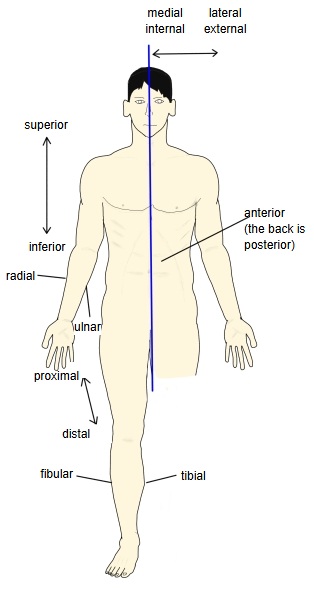 |
| 2 | inferior | Lower in position (nearer the feet) | |
| 3 | anterior | Nearer the front (ventral side) of the body | |
| 4 | posterior | Nearer the back (dorsal side) of the body | |
| 5 | medial | Nearer the median plane | |
| ulnar | Medial, in the upper limb (used especially for the forearm) | ||
| tibial | Medial, in the lower limb (used especially for the leg) | ||
| 6 | lateral | Farther from the median plane | |
| radial | Lateral, in the upper limb (used especially for the forearm) | ||
| fibular | Lateral, in the lower limb (used especially for the leg) | ||
| 7 | internal | Nearer the centre of a body cavity or an organ | |
| 8 | external | Farther from the centre of a body cavity or an organ | |
| 9 | proximal | In a limb, nearer its root (where it is attached to the trunk) | |
| 10 | distal | In a limb, farther from its root |
Planes
Any number of planes can pass through the body, but the three below are the ones used most often.
| No. | Plane | Description | Figure |
|---|---|---|---|
| 1 | sagittal plane | A vertical plane parallel to the sagittal suture of the skull; it divides the body into right and left parts and is perpendicular to the transverse axis. The sagittal plane that divides the body into equal right and left halves is the median (sagittal) plane. | 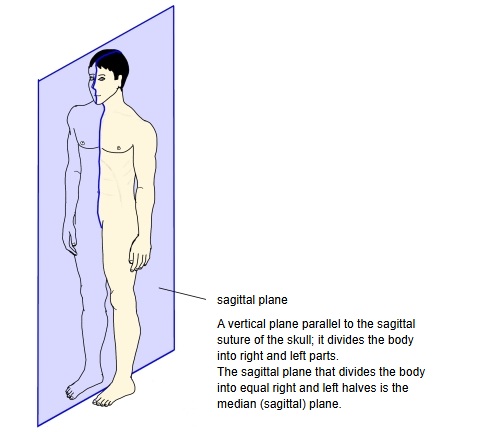 |
| 2 | coronal plane | A vertical plane parallel to the coronal suture of the skull; it divides the body into front and back parts and is perpendicular to the sagittal axis. Also called the frontal plane. | 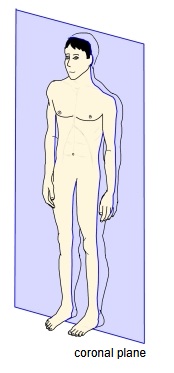 |
| 3 | horizontal plane | A plane that divides the body into upper and lower parts; it is perpendicular to the longitudinal axis. Also called the transverse plane. | 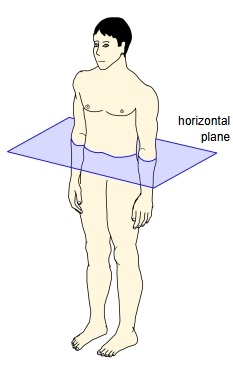 |
Axes
Any number of axes can pass through the body, but the three below are the ones used most often.
| No. | Axis | Description | Figure |
|---|---|---|---|
| 1 | longitudinal axis | Runs perpendicular to the ground, from head to foot. Also called the vertical axis. | 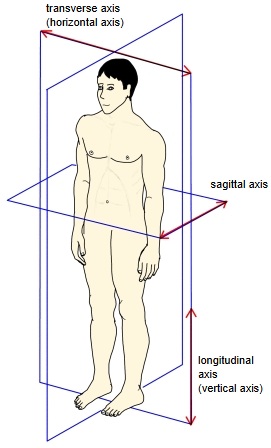 |
| 2 | sagittal axis | Runs parallel to the ground, from front to back; it is perpendicular to the coronal plane. | |
| 3 | transverse axis | Runs parallel to the ground, from side to side; it is perpendicular to the sagittal plane. Also called the horizontal axis. |