Latin: musculus longus colli
Overview
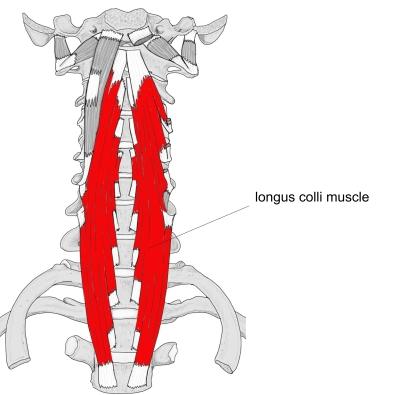
- One of the four prevertebral muscles of the deep neck.
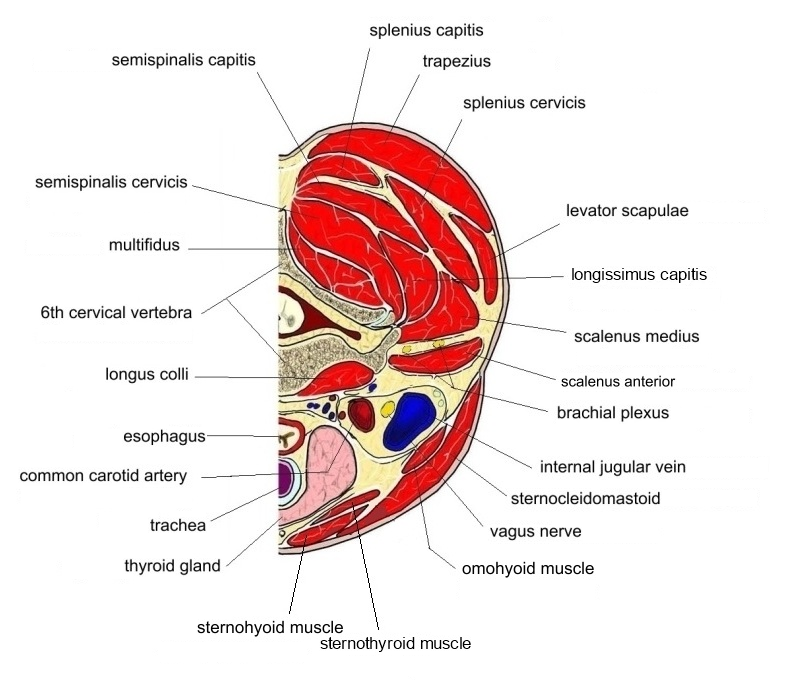
- Lies on the front of the vertebral column from the atlas to the 3rd thoracic vertebra, medial to the longus capitis.
- Broad in the middle, narrow and pointed at both ends.
- Three parts:
- Vertical part – the most medial
- Superior oblique part – lateral, upper
- Inferior oblique part – lateral, lower; the smallest
Position in the classification
Neck › Deep muscles of the neck › Prevertebral muscles
Illustrations
Origin / insertion
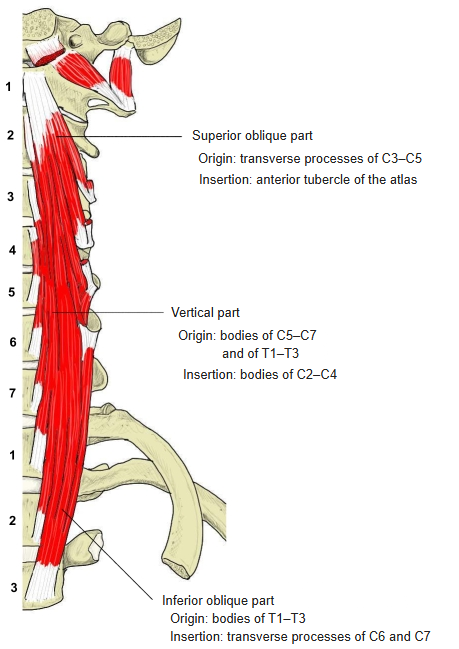
- Vertical part
- Origin: front of the bodies of C5–C7 and T1–T3
- Insertion: front of the bodies of C2–C4
- Superior oblique part
- Origin: transverse processes (anterior tubercles) of C3–C5
- Insertion: anterior tubercle of the atlas
- Inferior oblique part
- Origin: front of the bodies of T1–T3
- Insertion: anterior tubercles of the transverse processes of C5 and C6
Action
- Both sides: flex the cervical vertebral column
- One side: bends the neck to the same side and slightly rotates it
Innervation
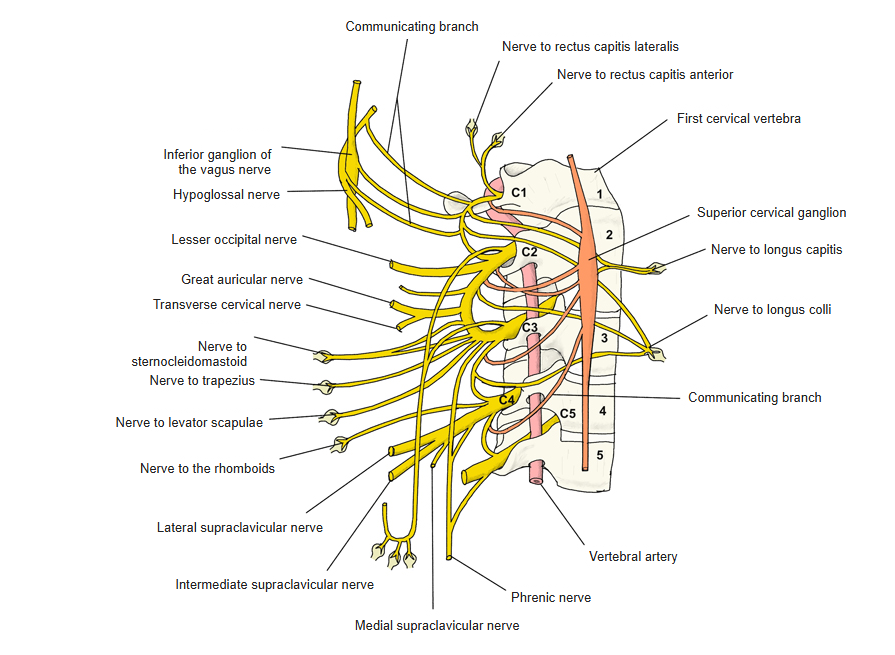
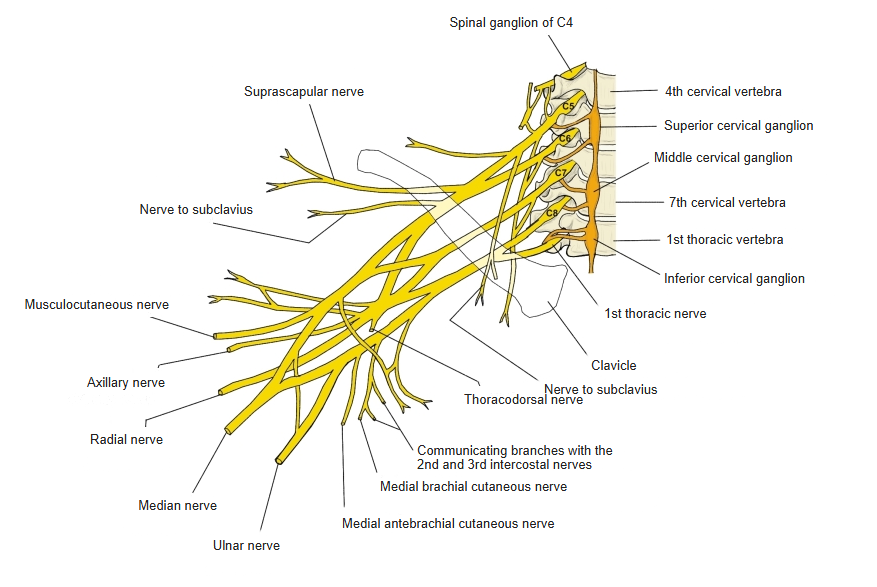
- Direct branches of the anterior rami of the cervical nerves (C2–C6; some sources C2–C7)
Blood supply
- Branches of the vertebral artery, the ascending cervical artery and the inferior thyroid artery
Related terms
- Prevertebral muscles
- Longus capitis
- Rectus capitis anterior
- Rectus capitis lateralis
- Nerve to longus colli
References and sources
- Further reading: Longus colli muscle, Wikipedia.
- Gray H. Anatomy of the Human Body, 20th ed. (1918), “5d. The Anterior Vertebral Muscles”, Bartleby.com.