Latin: musculus obliquus capitis inferior
Overview
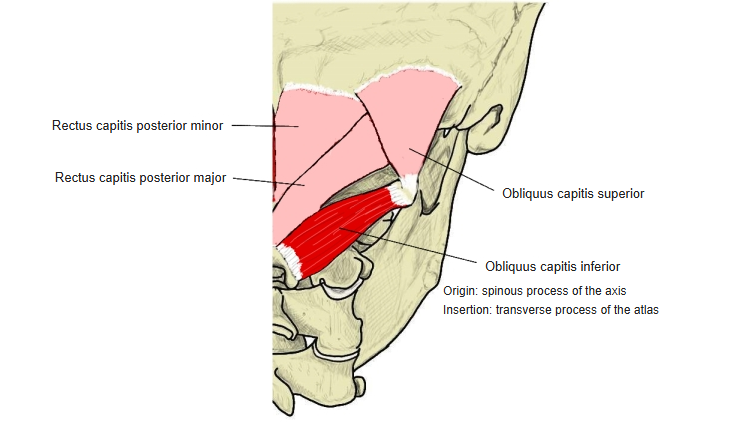
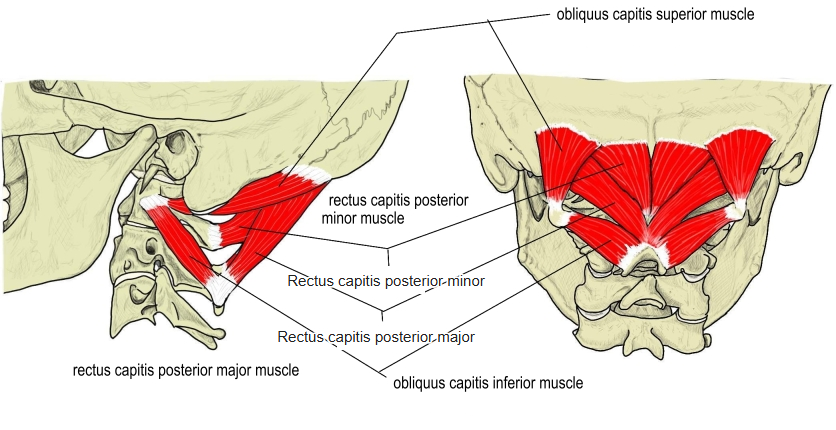
- One of the four suboccipital muscles, the larger of the two oblique ones.
- The only suboccipital muscle that does not attach to the skull, despite its name.
- Lies deep to the semispinalis capitis and trapezius; forms the lower border of the suboccipital triangle.
- Rich in muscle spindles: thought to be important for sensing head position.
Position in the classification
Trunk › Back › Deep back muscles › Second layer › Suboccipital muscles
- Rectus capitis posterior major
- Rectus capitis posterior minor
- Obliquus capitis inferior
- Obliquus capitis superior
Origin / insertion
- Origin: spinous process of the axis (C2)
- Insertion: transverse process of the atlas (C1)
Action
- Rotates the atlas and the head to the same side
Innervation
- Suboccipital nerve (posterior ramus of C1)
Compiled from standard anatomy references.
Blood supply
- Muscular branches of the vertebral artery and the occipital artery
Compiled from standard anatomy references.
Related terms
- Obliquus capitis superior
- Rectus capitis posterior major
- Rectus capitis posterior minor
- Suboccipital muscles
References and sources
- Further reading: Obliquus capitis inferior muscle, Wikipedia.