Latin: plexus mesentericus superior
Overview
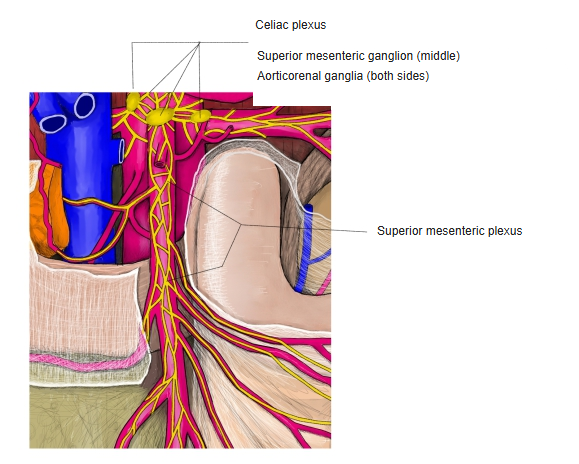
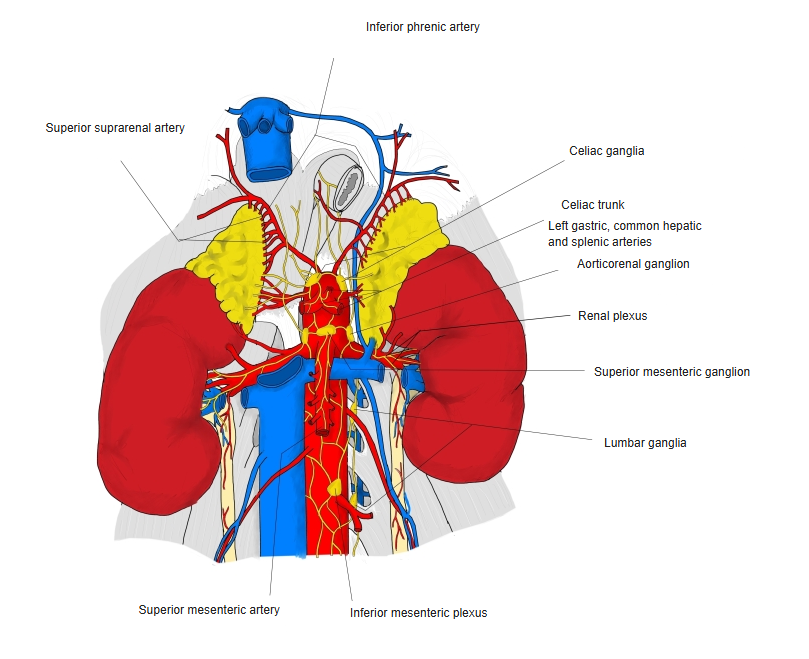
- The continuation of the lower part of the celiac plexus around the superior mesenteric artery; it contains both splanchnic (sympathetic) and vagal fibres.
- Its branches follow the artery to the head of the pancreas, the lower duodenum, the small intestine and the large intestine as far as part of the transverse colon; some follow the inferior pancreaticoduodenal artery and join the gastric plexus.
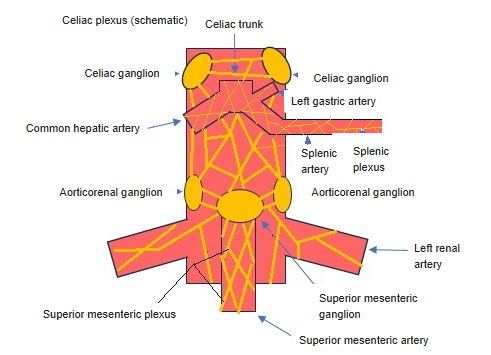
- The unpaired superior mesenteric ganglion lies in it below the origin of the artery.
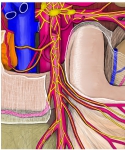
Superior mesenteric plexus 
Celiac plexus (schematic)
Plexuses in the gut wall
- Branches enter the wall of the stomach and intestine: under the serosa they form the subserous plexus, between the muscle layers the myenteric (Auerbach) plexus with many small ganglia, and in the submucosa the submucosal (Meissner) plexus.
- The myenteric plexus extends from the oesophagus to the rectum; the submucosal plexus is thinner and supplies glands, vessels and the mucosa.
Celiac and aorticorenal ganglia
References and sources
- Further reading: Superior mesenteric plexus, Wikipedia.