Latin: glandula mammaria
Overview
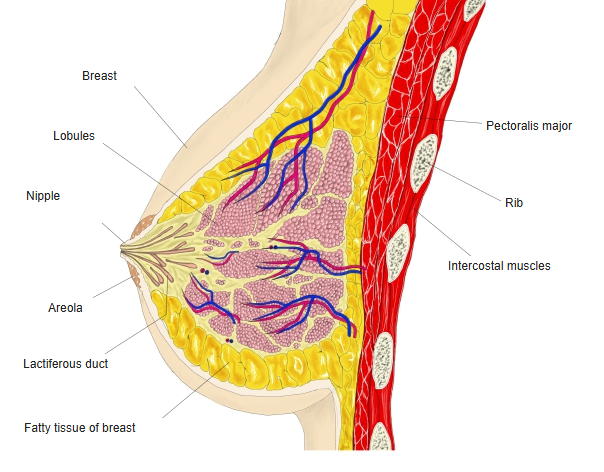
- The milk-producing gland inside the breast: a compound tubuloalveolar gland derived from modified sweat glands.
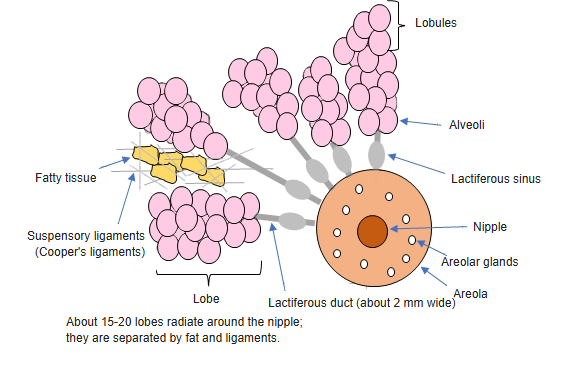
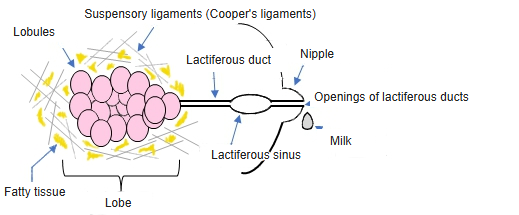
- Made of 15–20 lobes, each with its own lactiferous duct opening on the nipple.
- Each lobe consists of lobules; each lobule is a cluster of alveoli (secretory sacs) around small ducts.
- Develops at puberty and becomes fully active only in pregnancy and lactation.
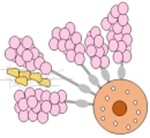
Lobes around the nipple (diagram) 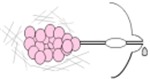
Lobe and duct system (diagram)
Function
- In pregnancy the ducts branch and the alveoli multiply under the influence of estrogen and progesterone.
- Prolactin stimulates milk production; oxytocin contracts the myoepithelial cells around the alveoli and ejects the milk during suckling.
- After lactation and after the menopause the glandular tissue regresses and is largely replaced by fat.
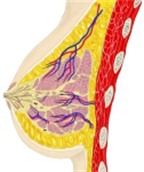
Breast, sagittal section
References and sources
- Further reading: Mammary gland, Wikipedia.