Latin: tuba uterina; salpinx
Overview
- Paired tube, about 10 cm long, from the side of the uterus to the ovary; also called the Fallopian tube.
- Carries the oocyte toward the uterus and sperm toward the oocyte.
- Fertilisation usually happens in its ampulla.
- Lies in the upper free border of the broad ligament (mesosalpinx).
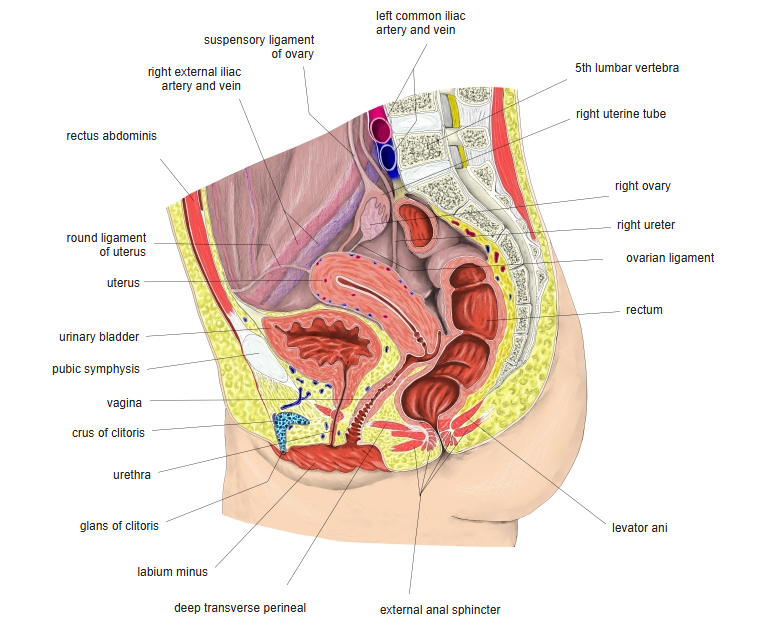
Female pelvis (median section)
Parts (from the ovary to the uterus)
| Part | Description |
|---|---|
| Infundibulum | Funnel-shaped end opening into the peritoneal cavity; fringed by fimbriae that sweep over the ovary |
| Ampulla | Widest and longest part; usual site of fertilisation |
| Isthmus | Narrow, thick-walled part next to the uterus |
| Uterine part | Passes through the uterine wall and opens into the cavity of the uterus |
- Mucosa in branching folds lined by ciliated and secretory cells; cilia and peristalsis move the oocyte toward the uterus.
- Implantation in the tube (ectopic pregnancy) is a surgical emergency.
References and sources
- Further reading: Uterine tube, Wikipedia.