Parietal tuber (Latin: tuber parietale)
Also called: parietal eminence
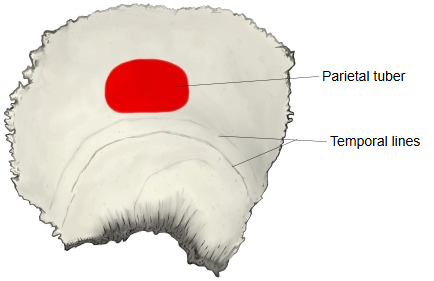
The raised area in the middle of the external (parietal) surface of the parietal bone, near its centre; it marks the place where ossification of the bone begins.
Ossification of the parietal bone starts here in the fetus, and the tuber is more prominent in the infant skull, giving the head a rounded, slightly angular shape seen from above. The two parietal tubers mark the widest part of the skull; the distance between them is the biparietal diameter, which is measured on fetal ultrasound.
Note: illustrations differ. In some the parietal tuber lies above the temporal lines; in others the temporal lines run across the tuber. Most drawings, like the figure on the right, show the tuber above the lines.
Reference websites
[Wikipedia]
· Parietal eminence, Wikipedia.
· Parietal bone, Wikipedia.
[Websites with illustrations]
· Left parietal bone, outer surface (Gray's Anatomy, fig. 132) (Wikimedia Commons)

⇒ Back to the parietal bone page
Where it is found
Related terms
References and sources
- Further reading: Parietal eminence, Wikipedia.
- Further reading: Parietal bone, Wikipedia.
- Federative International Programme for Anatomical Terminology (FIPAT). Terminologia Anatomica, 2nd ed. (TA2), 2019.