Latin: musculi intertransversarii posteriores cervicis
Overview
- One of the intertransversarii, the short muscles between the transverse processes of adjacent vertebrae.
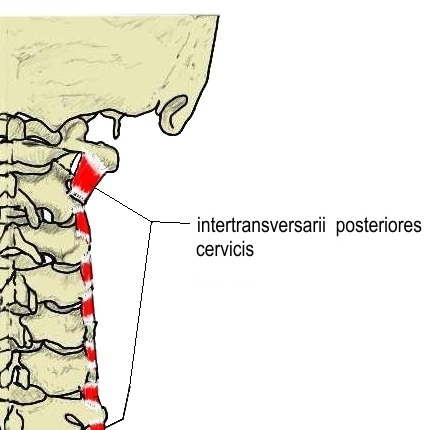
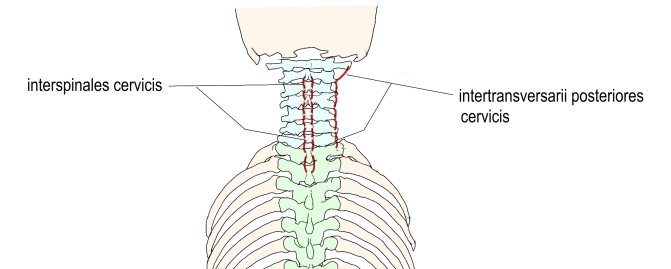
- Each muscle connects the posterior tubercles of the transverse processes of two adjacent cervical vertebrae.
- In the neck the intertransversarii are best developed and are arranged in pairs (an anterior and a posterior muscle), separated by the anterior ramus of a cervical spinal nerve.
- There are seven pairs of each set.
Position in the classification
Trunk › Back › Deep back muscles › Second layer › Intrinsic back muscles › Others
- Interspinales thoracis
- Interspinales cervicis muscles
- Intertransversarii posteriores cervicis
- Intertransversarii laterales lumborum
- Medial lumbar intertransversarii muscles
Origin / insertion
- Origin: posterior tubercle of the transverse process of the vertebra below
- Insertion: posterior tubercle of the transverse process of the vertebra above
- Uppermost pair: between the atlas (C1) and the axis (C2)
- Lowest pair: between the seventh cervical (C7) and the first thoracic (T1) vertebrae
Action
- Laterally flexes the neck to the same side and stabilizes the cervical vertebrae
This is the action usually described for the intertransversarii.
Innervation
- Anterior rami of the cervical spinal nerves
In some descriptions the posterior cervical intertransversarii are divided into a medial part supplied by the posterior rami and a lateral part supplied by the anterior rami.
Related terms
- Intertransversarii
- Intertransversarii anteriores cervicis
- Interspinales cervicis
- Posterior tubercle of the transverse process
References and sources
- Further reading: Intertransversarii, Wikipedia.