Latin: musculus semispinalis cervicis
Overview
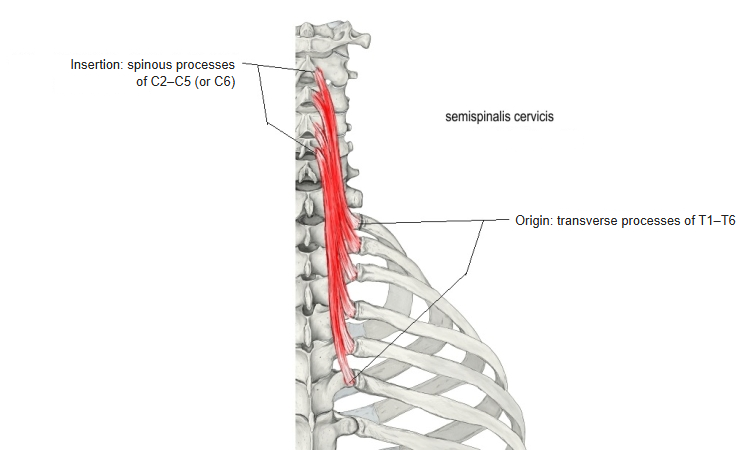
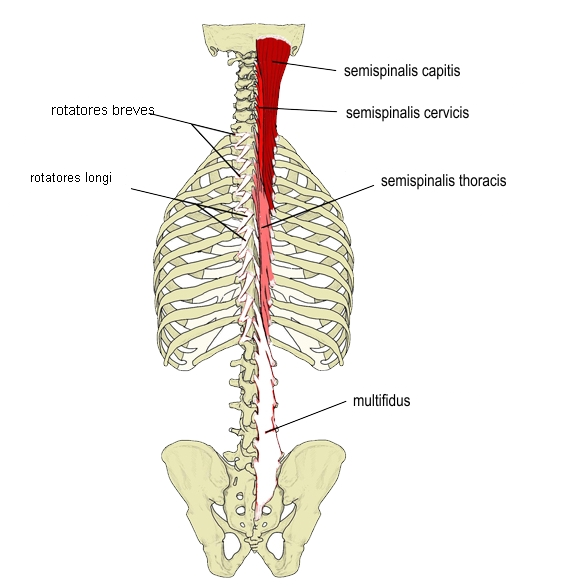
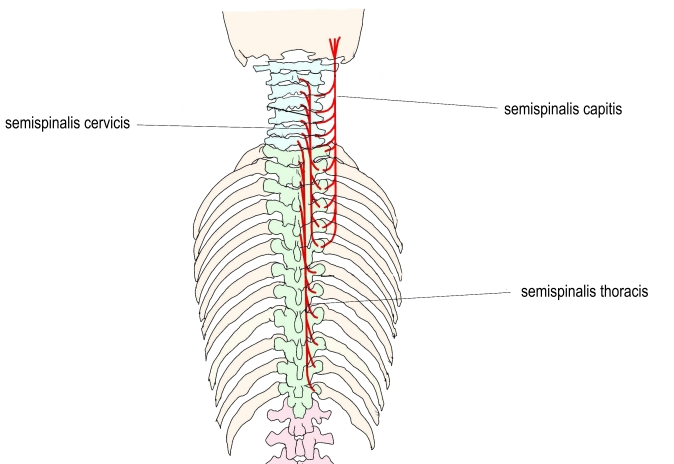
- The neck part of the semispinalis (capitis, cervicis, thoracis), one of the transversospinales.
- Lies deep to the semispinalis capitis; thicker than the semispinalis thoracis.
- The bundle to the axis is the largest and mostly fleshy.
- The semispinalis cervicis and thoracis often form a single unit.
Position in the classification
Trunk › Back › Deep back muscles › Second layer › Intrinsic back muscles › Transversospinalis
- Semispinalis thoracis
- Semispinalis cervicis
- Semispinalis capitis
- Multifidus
- Rotatores breves
- Rotatores longi
Illustrations
Origin / insertion
- Origin: transverse processes of the upper five or six thoracic vertebrae
- Insertion: spinous processes of C2–C5 (some sources: C2–C6)
- Each bundle crosses at least five, usually six or seven vertebrae.
Action
- Extends the cervical vertebral column
- Acting on one side, rotates it to the opposite side
Given for the semispinalis as a whole.
Innervation
- Posterior rami of the lower three cervical nerves
- For the semispinalis as a whole: medial branches of the posterior rami of C2–C8 and T1–T7
Blood supply
- Muscular branches of the posterior intercostal arteries
- Descending branch of the occipital artery
- Deep cervical branch of the costocervical trunk
Related terms
- Semispinalis
- Semispinalis capitis
- Semispinalis thoracis
- Transversospinales
- Multifidus
- Spinous process
References and sources
- Further reading: Semispinalis muscles, Wikipedia.