Latin: musculi rotatores breves
Overview
- The rotatores as a whole: the short rotatores (this entry) pass to the vertebra directly above, the long rotatores to the second vertebra above.
- The deepest of the intrinsic back muscles, lying beneath the multifidus.
- Present in all regions of the spine but best developed in the thoracic region (rotatores thoracis), where there are eleven on each side (Wikipedia).
- Each is small and roughly quadrilateral.
- Rich in proprioceptors and probably involved in the control of posture (Wikipedia).
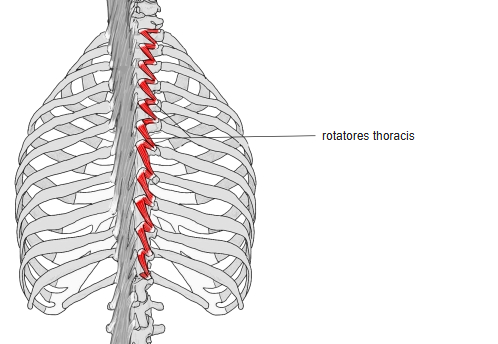
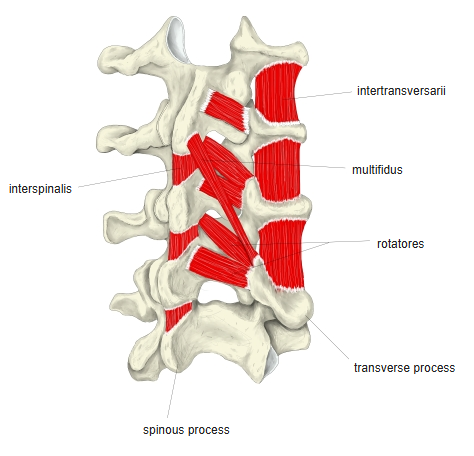
Position in the classification
Trunk › Back › Deep back muscles › Second layer › Intrinsic back muscles › Transversospinalis
- Semispinalis thoracis
- Semispinalis cervicis
- Semispinalis capitis
- Multifidus
- Rotatores breves
- Rotatores longi
Illustrations
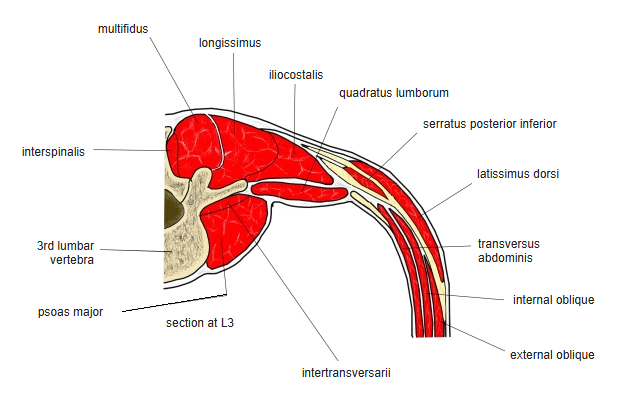
Origin / insertion
- Origin: transverse processes of the vertebrae except the atlas (in the lumbar region, the costal processes); the fibres run upwards and medially
- Insertion: lamina of the vertebra one (short rotatores) or two (long rotatores) levels above (Wikipedia)
- Some sources: the spinous process of the vertebra directly above
Action
- Help to rotate the vertebral column
Innervation
- Medial branches of the dorsal rami of the spinal nerves
Blood supply
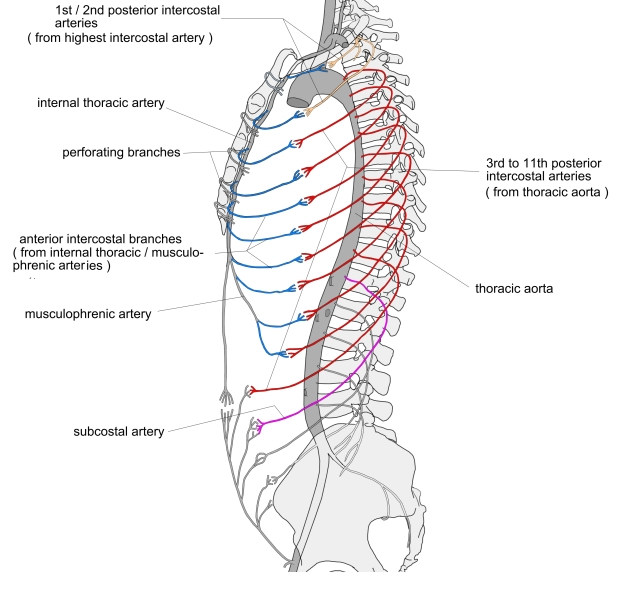
- Muscular branches of the intercostal arteries
Related terms
- Multifidus
- Semispinalis
- Transversospinales
- Transverse process
- Lamina of the vertebral arch
- Spinal nerve
References and sources
- Further reading: Rotatores muscles, Wikipedia.