Vermiform appendix (Latin: appendix vermiformis)
- Overview
- Structure
- Functions
- Others (position, mesoappendix)
- Arteries / veins / nerves / lymphatics
- Related terms
- References
Overview
· The cecum is the first place the contents of the small intestine enter, and, like a checkpoint, it has a well-developed immune function for defence.
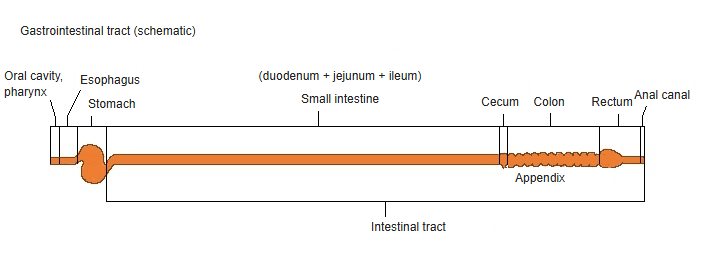
(schematic) (click to enlarge)
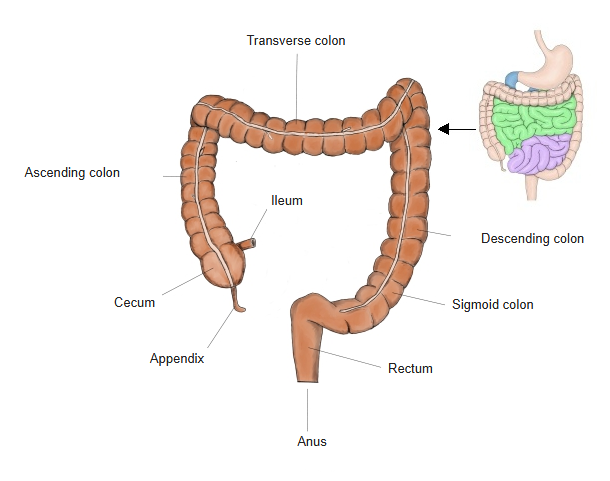
Structure
Two outstanding features particular to the appendix are as follows.
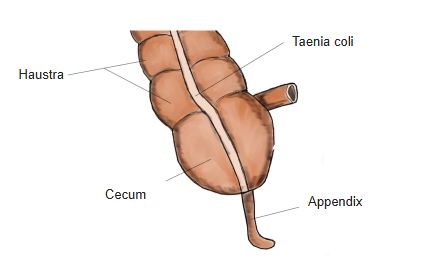
1. Lymphoid tissue (follicles) is extremely abundant. The appendix is called the "tonsil of the abdomen" because lymphoid tissue is packed into its submucosa. This tissue shrinks with age, which is also characteristic of the appendix.
2. There are no taeniae coli. The cecum and the rest of the large intestine have taeniae coli and therefore the typical bulges (haustra); the appendix has no taeniae, so it has no haustra.
Functions
· It takes almost no part in secreting digestive enzymes or absorbing nutrients.
Its main functions are as follows.
1. A "refuge" for gut bacteria
When the gut bacteria are washed out, for example by severe diarrhoea, beneficial bacteria that sheltered in the appendix are supplied to the intestine again.
2. An immune "training centre"
· The appendix has very well-developed lymphoid tissue (collections of immune cells) and produces large amounts of the immune antibody IgA.
· Control of the gut environment: immune cells made here move to the small and large intestines, where they help to keep the gut bacteria in balance and protect the body from pathogens.
· "Tonsil of the intestine": like the tonsils of the throat, it watches for and attacks invaders, acting as a gatekeeper.
Others
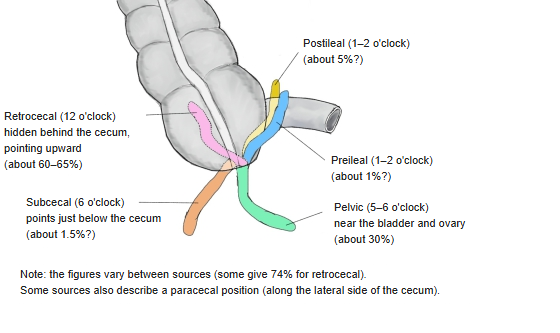
[Position]
The direction in which the appendix points varies greatly between individuals and is often described by comparison with the hands of a clock.
Vessels and nerves
[Arteries]
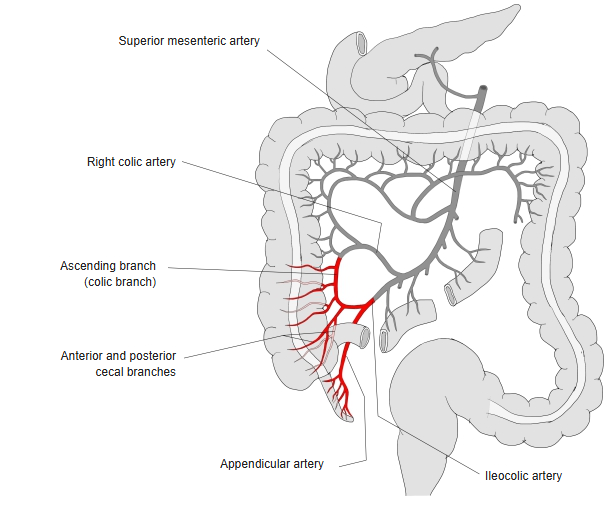
The appendicular artery (a branch of the ileocolic artery).
artery
- Ascending (colic) branch : runs upwards, giving branches to the ascending colon. Anastomosis: a branch of the right colic artery.
- Anterior cecal branch : supplies the front of the cecum.
- Posterior cecal branch : supplies the back of the cecum; often variable.
- Appendicular artery : supplies the appendix; often variable.
[Veins]
Appendicular vein ⇒ ileocolic vein ⇒ superior mesenteric vein.
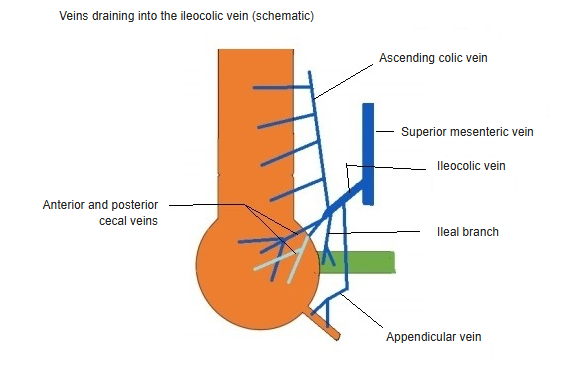
ileocolic vein (click to enlarge)
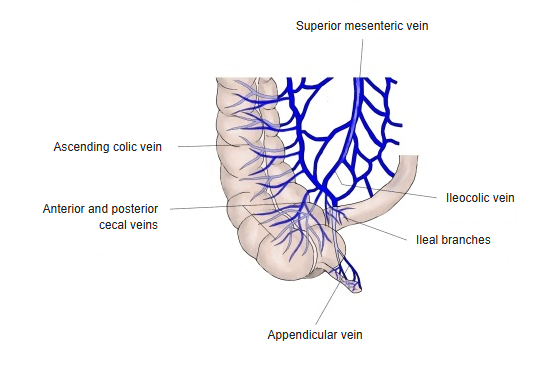
ileocolic vein
- Ileal branch : collects blood from the terminal ileum (especially near the ileocecal region).
- Ascending colic branch : collects blood from the proximal ascending colon.
- Anterior cecal vein : collects blood from the front of the cecum.
- Posterior cecal vein : collects blood from the back of the cecum.
- Appendicular vein : collects blood from the appendix.
[Nerves]
The appendix is supplied mainly by autonomic nerves; the following take part.
· Sympathetic: nerves from about the 10th thoracic segment of the spinal cord (T10) reach it through the superior mesenteric ganglion and the superior mesenteric plexus.
· Parasympathetic: the vagus nerve plays this role, regulating movements of the intestine (peristalsis) and so on.
[Lymphatics]
The lymphatic system of the appendix consists mainly of the lymphoid tissue inside the appendix and the lymph vessels and lymph nodes that carry fluid away from it. The appendix contains a great deal of lymphoid tissue and plays an important role in the immune system.
of the appendix
- Command centre of the immune responses of the large intestine
- Aggregated lymphoid nodules of the appendix : in the submucosa; centred on B lymphocytes producing antibody (IgA).
Related terms
Main anatomical terms related to the appendix, in alphabetical order.
| A | Appendicular artery, Appendicular vein, Appendiceal orifice |
| C | Cecum |
| I | Ileocolic artery, Ileocolic vein |
| M | Mesoappendix |
| T | Taeniae coli |
References and sources
- Further reading: Appendix (anatomy), Wikipedia.