Latin: tela subcutanea
Overview
- The layer of loose connective tissue and fat beneath the dermis; it attaches the skin loosely to the deep fascia, muscles and bones.
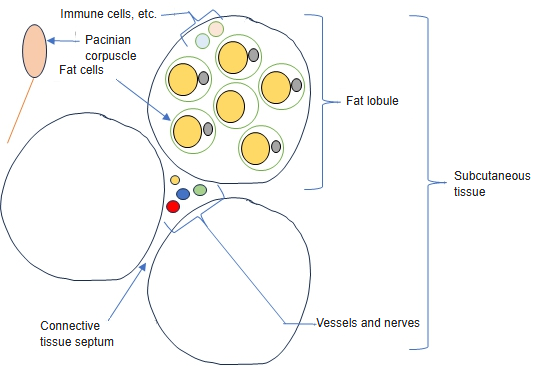
- Fat cells are grouped in fat lobules separated by connective tissue septa that carry vessels and nerves.
- Thickness varies with body region, sex and nutrition; almost no fat in the eyelids, penis and scrotum.
- Functions: energy store, heat insulation, cushioning, and mobility of the skin.
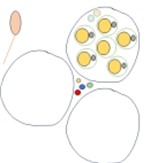
Subcutaneous tissue (diagram) 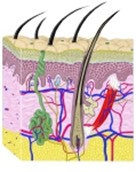
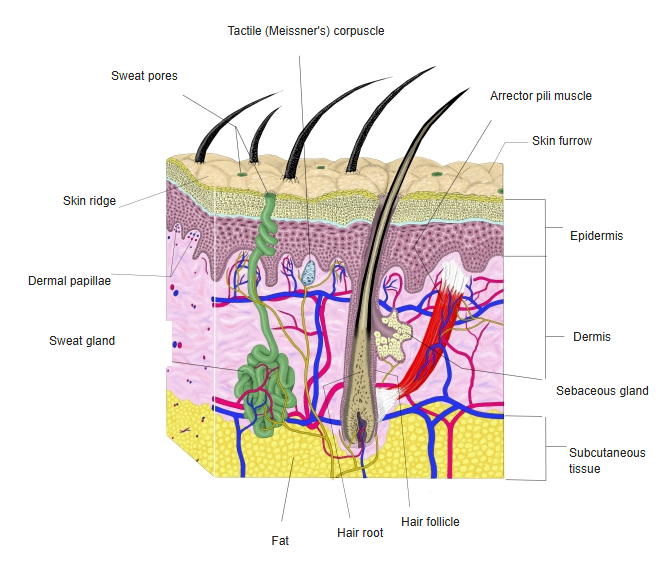
Skin, block diagram
Contents
- Larger arteries, veins and lymph vessels supplying the skin; cutaneous nerves.
- Lamellar (Pacinian) corpuscles for vibration and deep pressure.
- Deep parts of hair follicles and of sweat glands.
- In some regions, skin muscles (such as the platysma and the dartos).
- Subcutaneous injections are given into this layer.
References and sources
- Further reading: Hypodermis (subcutaneous tissue), Wikipedia.