Latin: ductus semicirculares
Overview
- Three membranous ducts inside the semicircular canals – anterior, posterior and lateral – which sense rotation of the head.
- They are much narrower than the bony canals and lie against their outer walls; they are filled with endolymph.
- Each opens into the utricle at both ends; one end is widened into a membranous ampulla.
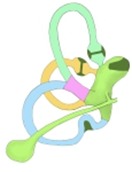
Semicircular ducts 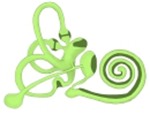
Membranous labyrinth
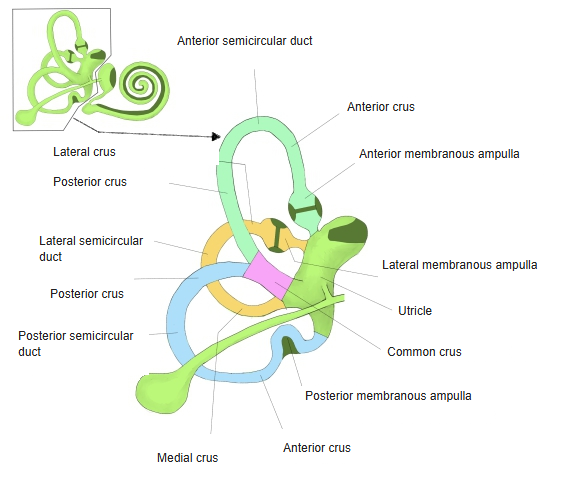
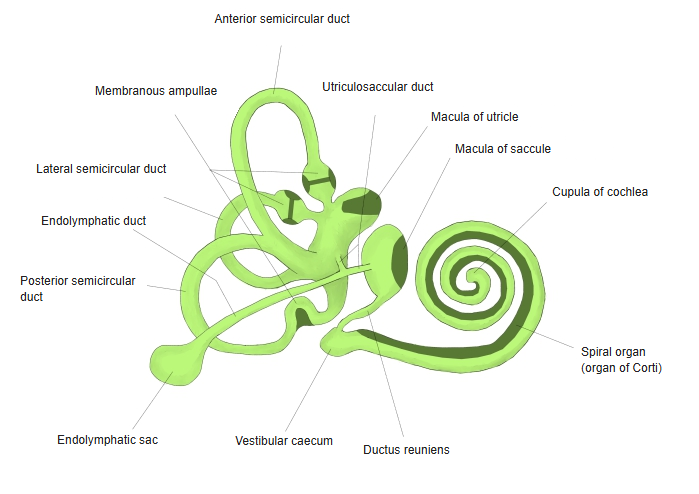
Ampullary crest
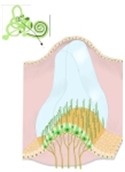
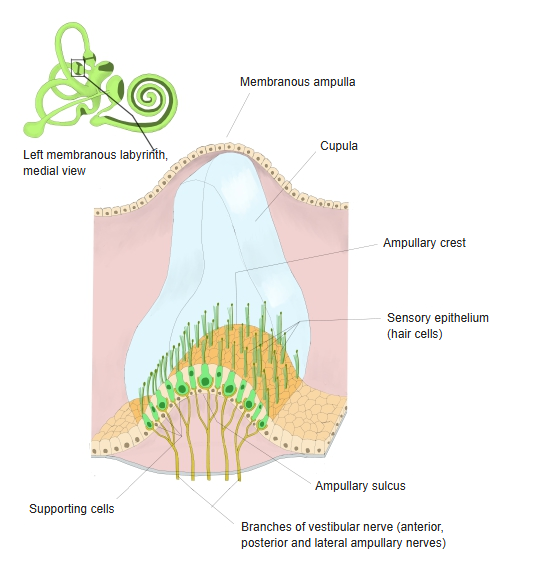
- In each ampulla a transverse ridge, the ampullary crest, carries hair cells and supporting cells.
- The hair bundles project into the cupula, a gelatinous mass that spans the ampulla like a swing door.
- When the head turns, the endolymph lags behind, bends the cupula and stimulates the hair cells.
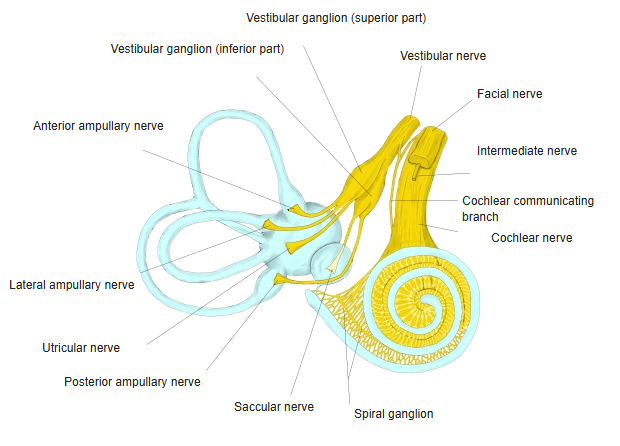
- Fibres run in the anterior, lateral and posterior ampullary nerves to the vestibular nerve.
Ampullary crest 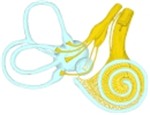
Nerves of the membranous labyrinth
References and sources
- Further reading: Semicircular ducts, Wikipedia.