Latin: musculi interspinales cervicis
Overview
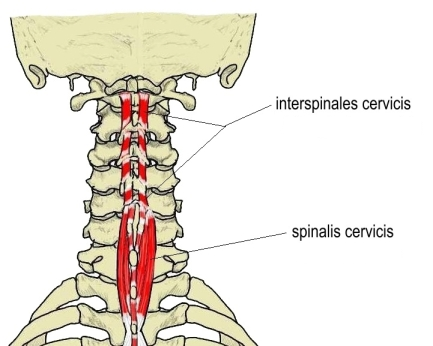
- Short muscle bundles joining the spinous processes of neighbouring cervical vertebrae, in pairs, one on each side of the interspinous ligament.
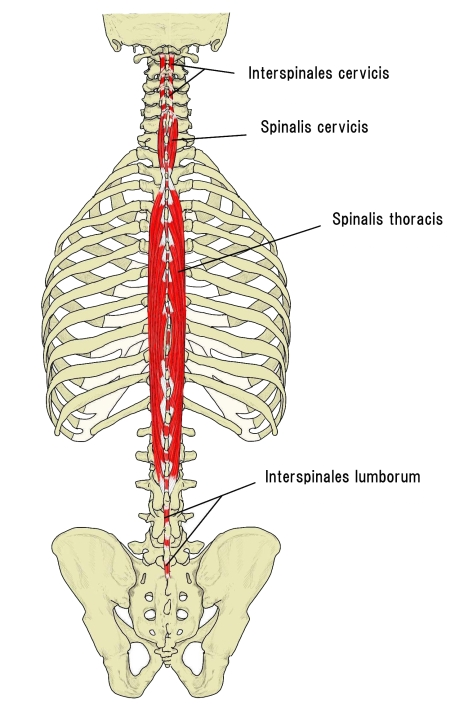
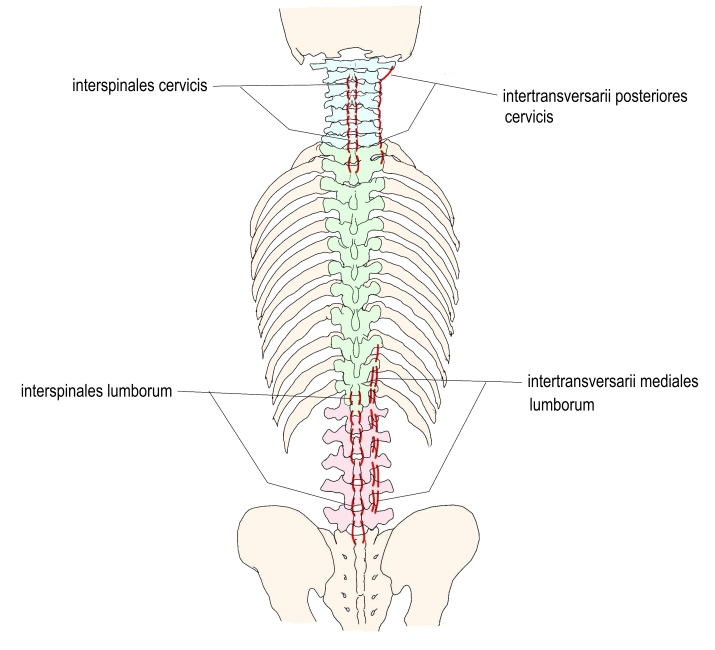
- The interspinales are most distinct in the neck: usually six pairs, the first between the axis (C2) and C3, the last between C7 and T1.
- In the neck they are often divided into two slips, because the cervical spinous processes are bifid.
- The thoracic interspinales are often absent or poorly developed; the lumbar interspinales are present at every level.
Position in the classification
Trunk › Back › Deep back muscles › Second layer › Intrinsic back muscles › Others
Illustrations
Origin / insertion
- Origin: apex of the spinous process of a cervical vertebra (the lower vertebra)
- Insertion: apex of the spinous process of the vertebra immediately above
Action
- Extends the neck (cervical vertebral column)
Innervation
- Posterior (dorsal) rami of the cervical spinal nerves
Related terms
- Interspinales thoracis
- Interspinales lumborum
- Interspinales
- Spinalis cervicis
- Intertransversarii
- Spinous process
- Interspinous ligament
References and sources
- Further reading: Interspinales muscles, Wikipedia.