Latin: musculus rectus capitis posterior major
Overview
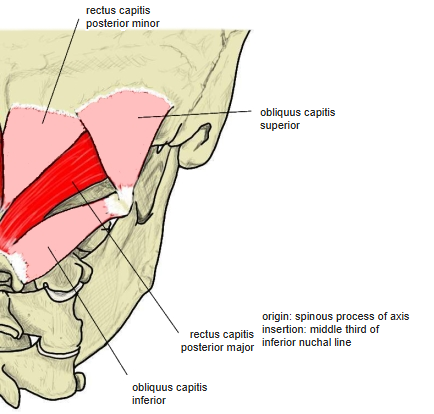
- One of the four suboccipital muscles. These correspond to the uppermost part of the rotatores and related muscles, except the obliquus capitis superior, which has a different nerve supply and belongs to the longissimus system.
- Arises by a pointed tendon and widens as it rises.
- The muscles of both sides leave a triangle between them, in which the rectus capitis posterior minor is seen.
- A soft-tissue bridge from this muscle to the cervical dura mater was described in 2011 (Wikipedia).
Position in the classification
Trunk › Back › Deep back muscles › Second layer › Suboccipital muscles
- Rectus capitis posterior major
- Rectus capitis posterior minor
- Obliquus capitis inferior
- Obliquus capitis superior
Origin / insertion
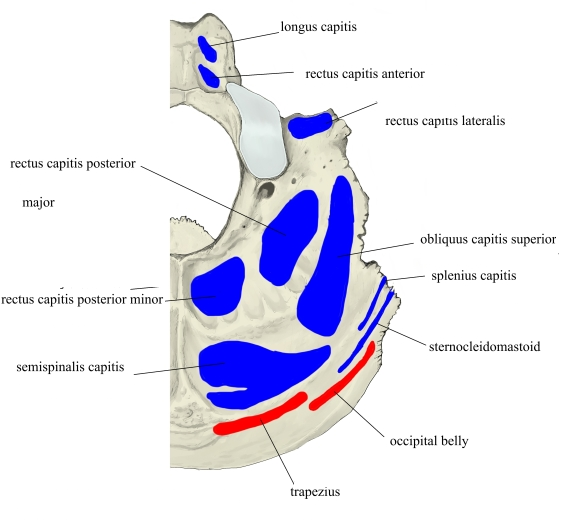
- Origin: spinous process of the axis
- Insertion: middle third of the inferior nuchal line of the occipital bone
Action
- Pulls the head back
- Acting on one side, turns the head to the same side
Innervation
- Suboccipital nerve (dorsal ramus of the 1st cervical nerve, C1)
Blood supply
- Not given in the sources used here
Anatomical variations
- A rectus capitis posterior medius may appear between the major and minor muscles
Related terms
- Rectus capitis posterior minor
- Obliquus capitis superior
- Obliquus capitis inferior
- Axis
- Occipital bone
- Suboccipital nerve
References and sources
- Further reading: Rectus capitis posterior major muscle, Wikipedia.