Latin: musculus semispinalis thoracis · also called the semispinalis dorsi
Overview
- The thoracic part of the semispinalis (capitis, cervicis, thoracis).
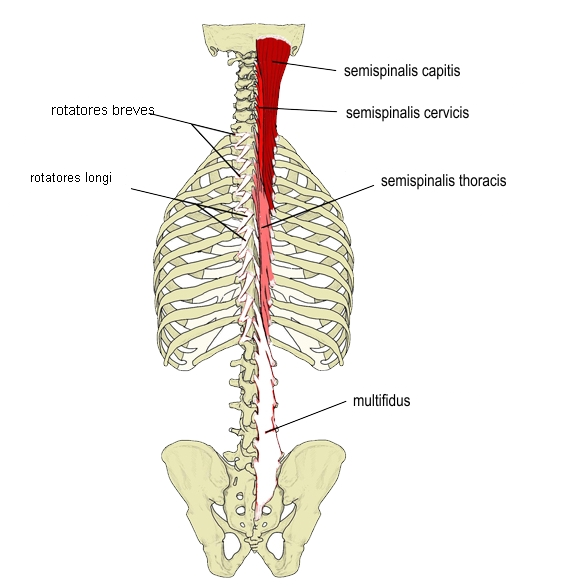
- The semispinalis belongs to the transversospinales of the intrinsic back muscles (deep back muscles, second layer); it is the most superficial of them — the rotatores are the deepest.
- It is covered by the longissimus and the spinalis.
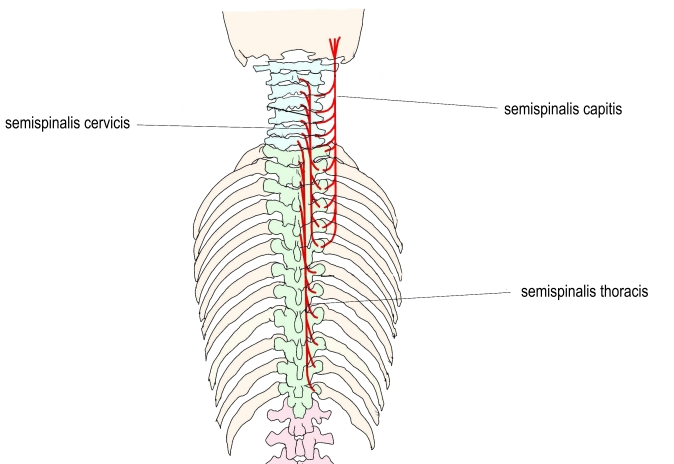
- Thin, narrow muscle bundles alternate with long tendons; each bundle crosses at least five, usually six or seven vertebrae.
Position in the classification
Trunk › Back › Deep back muscles › Second layer › Intrinsic back muscles › Transversospinalis
- Semispinalis thoracis
- Semispinalis cervicis
- Semispinalis capitis
- Multifidus
- Rotatores breves
- Rotatores longi
Illustrations
Origin / insertion
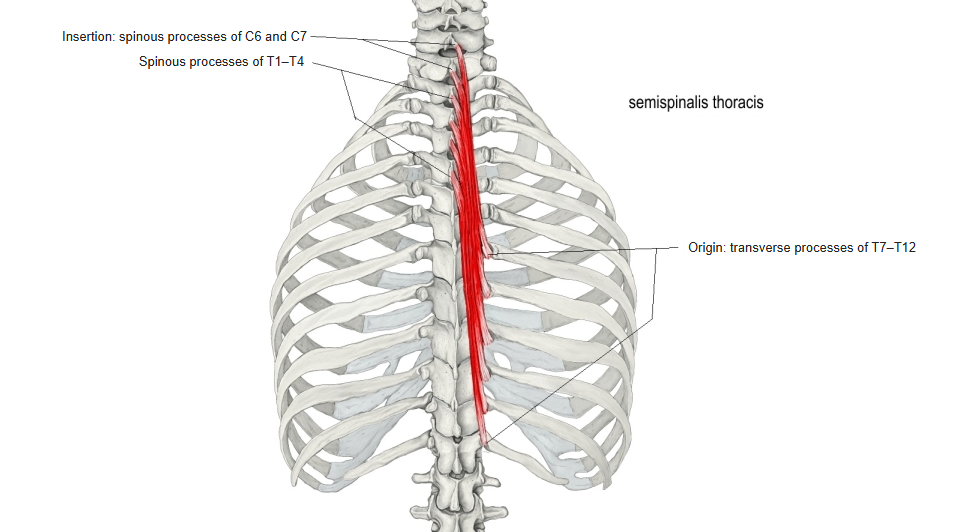
- Origin: transverse processes of the lower six thoracic vertebrae (T7–T12)
- Insertion: spinous processes of the lower two cervical and upper four thoracic vertebrae (C6–T4)
Some sources give the transverse processes of T6–T10 as the origin.
Action
- Bilateral: extends the vertebral column (bends it backward)
- Unilateral: turns the vertebral column to the opposite side; bends it to the same side
Innervation
- Medial branches of the posterior (dorsal) rami of the upper six thoracic nerves
Blood supply
- Muscular branches of the posterior intercostal arteries
- Descending branch of the occipital artery and deep cervical branch of the costocervical trunk
Related terms
- Semispinalis capitis
- Semispinalis cervicis
- Transversospinales
- Multifidus
- Rotatores
- Spinous process
- Transverse process
References and sources
- Further reading: Semispinalis muscles, Wikipedia.