Nasolabial sulcus (Latin: sulcus nasolabialis)
Also called: nasolabial groove; nasolabial fold; smile line; laugh line
· It corresponds roughly to what is commonly called the smile line or laugh line.
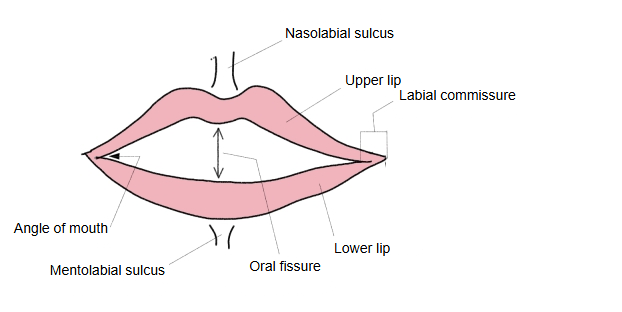
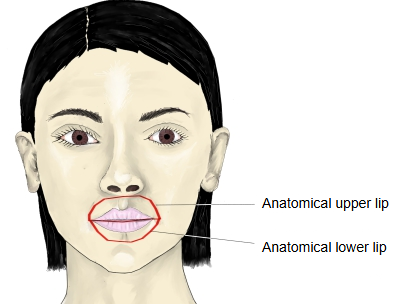
The furrow runs from the side of the nose to just beyond the angle of the mouth and marks the lateral border of the anatomical upper lip. In everyday and clinical use, nasolabial fold usually means the bulge of cheek tissue just lateral to the furrow; the furrow itself is the sulcus. It forms where fibres of the lip elevators, such as levator labii superioris, levator labii superioris alaeque nasi and zygomaticus major, reach the skin, with the fat of the cheek lying lateral to it; the orbicularis oris lies medial to it in the lip. It deepens when smiling and generally with age. A flattened sulcus on one side is a classic sign of facial nerve palsy.
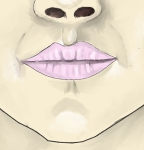 Surface features of the lips
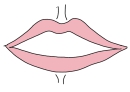 Lips (schematic)
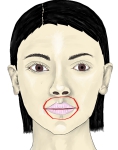 Anatomical lips
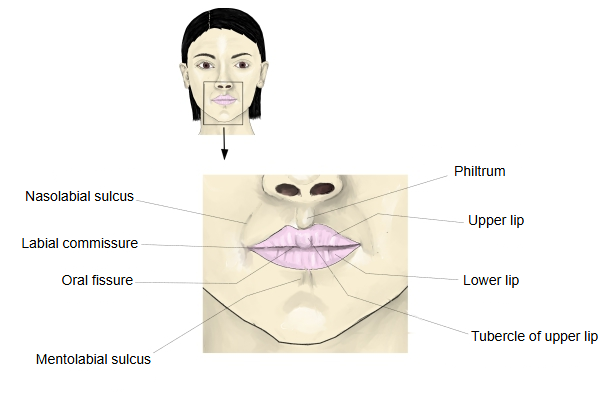
Reference websites
[Wikipedia]
· Nasolabial fold, Wikipedia.
· Lip, Wikipedia.
[Websites with illustrations]
· Surface anatomy of the lips (THANC Guide)

· Surface features of the face and lips (pocketdentistry.com)

Related terms
- Upper lip
- Oral cavity
- Orbicularis oris
- Levator labii superioris
- Levator labii superioris alaeque nasi
- Zygomaticus major
References and sources
- Further reading: Nasolabial fold, Wikipedia.
- Further reading: Lip, Wikipedia.
- Federative International Programme for Anatomical Terminology (FIPAT). Terminologia Anatomica, 2nd ed. (TA2), 2019.