Latin: cavitas oris
Overview
- The first part of the digestive tract, from the lips to the isthmus of fauces, where it opens into the pharynx.
- Also part of the upper airway (mouth breathing) and important for speech.
- In the embryo the primitive mouth is divided by the developing palate into the nasal cavity above and the oral cavity below.
- Contains the teeth and the tongue; the ducts of the salivary glands open into it.
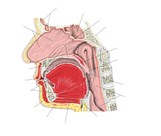
Median section of the head 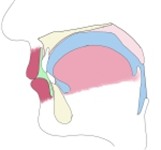
Oral cavity (schematic section) 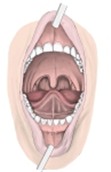
Oral cavity from the front
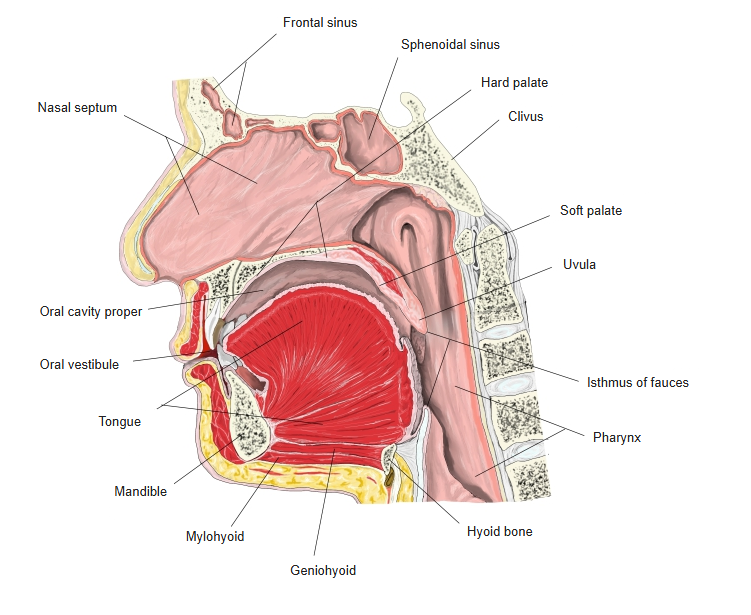
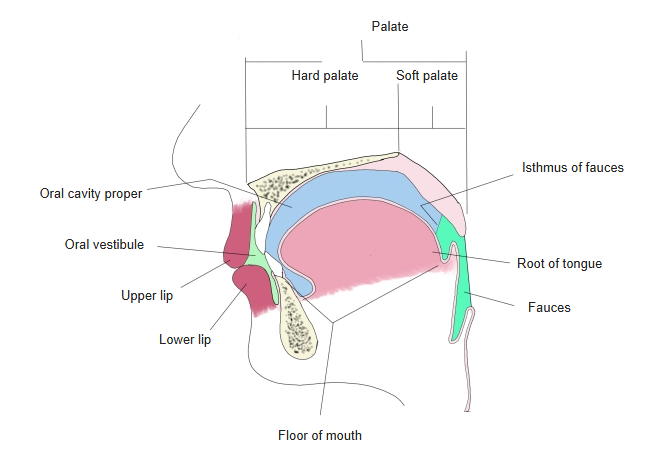
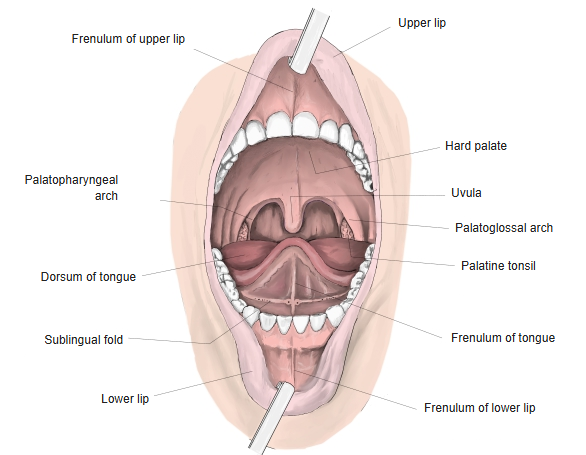
Parts and boundaries
| Part | Description |
|---|---|
| Oral vestibule | Narrow space between the lips and cheeks outside and the teeth and gums inside; the parotid duct opens here opposite the upper second molar |
| Oral cavity proper | Space inside the dental arches, filled mostly by the tongue; communicates with the vestibule behind the last molars |
| Roof | Hard palate in front, soft palate with the uvula behind |
| Floor | Tongue and the mucosa under it (sublingual folds and caruncles), supported by the mylohyoid and geniohyoid |
| Lateral walls | Cheeks, with the buccinator |
| Front | The lips (oral fissure), joined to the gums by the frenula of the upper and lower lip |
| Back | Isthmus of fauces, bounded by the palatoglossal arches, with the palatine tonsils between the palatoglossal and palatopharyngeal arches |
References and sources
- Further reading: Oral cavity, Wikipedia.