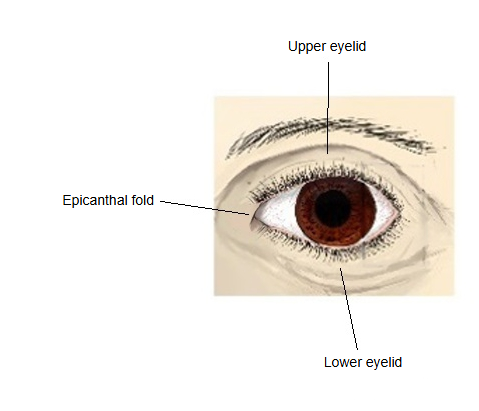
Epicanthal fold (Latin: plica palpebronasalis)
Also called the epicanthus, epicanthic fold, palpebronasal fold
Note: in English the fold is usually called the epicanthal fold or epicanthic fold; other names are epicanthus and palpebronasal fold (sources differ on the name).
Medical dictionaries explain these names as the fold of skin of the upper eyelid that covers the medial canthus.
In everyday use the names are sometimes linked with a 'monolid' (an upper eyelid without a visible crease). The two often occur together, but the epicanthal fold is not the same as the upper eyelid crease or its absence.
· Some anatomy texts do not use this name and use instead palpebronasal fold (plica palpebronasalis). The fold is common in East Asian populations and in young children of all populations; in many children it fades as the bridge of the nose grows. A marked fold is also a feature of some conditions, such as Down syndrome.
Reference websites
[Wikipedia]
· Epicanthic fold, Wikipedia.
[Websites with illustrations]
· Four types of epicanthus (inversus, palpebralis, supraciliaris, tarsalis) (Entokey)

· Monolid with epicanthal fold, and double lid (Cleveland Clinic)
Related terms
References and sources
- Further reading: Epicanthic fold, Wikipedia.
- Federative International Programme for Anatomical Terminology (FIPAT). Terminologia Anatomica, 2nd ed. (TA2), 2019.