Corrugator cutis ani (Latin: musculus corrugator cutis ani)
Overview
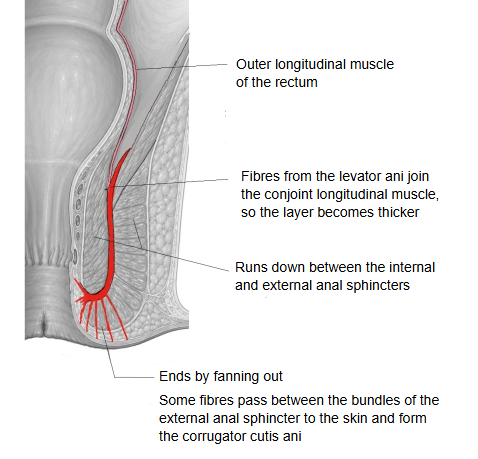
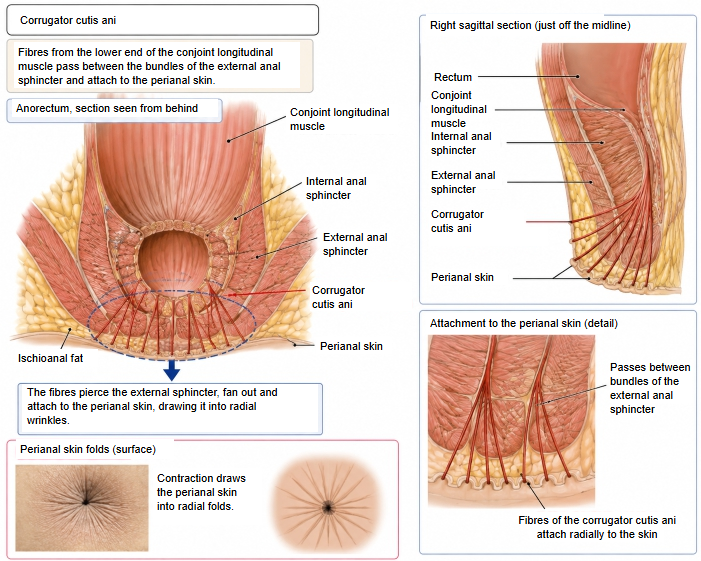
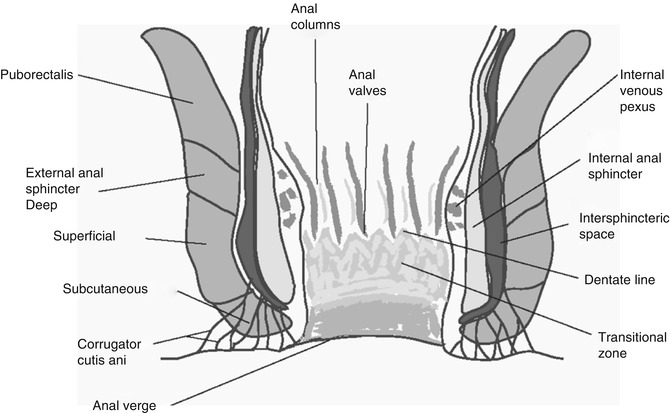
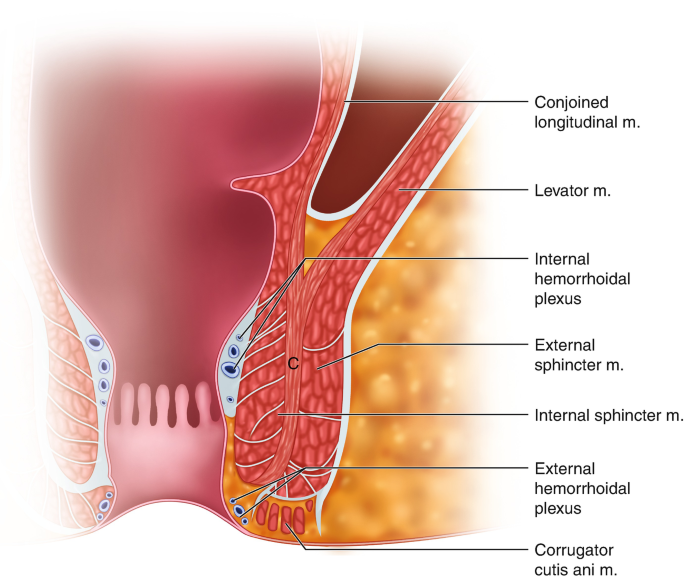
The corrugator cutis ani is formed by part of the conjoint longitudinal muscle of the anal canal: at its lower end these strands pass between the bundles of the external anal sphincter and reach the skin around the anus.
Conjoint longitudinal muscle: the outer longitudinal muscle of the rectum, joined by fibres of the levator ani
· Other smooth muscles in the skin that wrinkle it in a similar way are found in the skin of the scrotum (the dartos) and beneath the areola of the nipple.
It is smooth muscle that pulls the skin around the anus into radial wrinkles, and it is controlled by the autonomic nerves (sympathetic and parasympathetic).
Sympathetic: for example the hypogastric nervesParasympathetic: for example the pelvic splanchnic nerves
· Its contraction gathers the skin around the anus into radiating folds. Being smooth muscle, it is not under voluntary control.
Sites with photos and illustrations
· Illustrations and photos: site I
· Illustrations and photos: site II
· Illustrations and photos: site III

Related terms
References and sources
- Further reading: Anal canal, Wikipedia.
- Further reading: Internal anal sphincter, Wikipedia.
- Federative International Programme for Anatomical Terminology (FIPAT). Terminologia Anatomica, 2nd ed. (TA2), 2019.