Hilum of lymph node (Latin: hilum nodi lymphoidei)
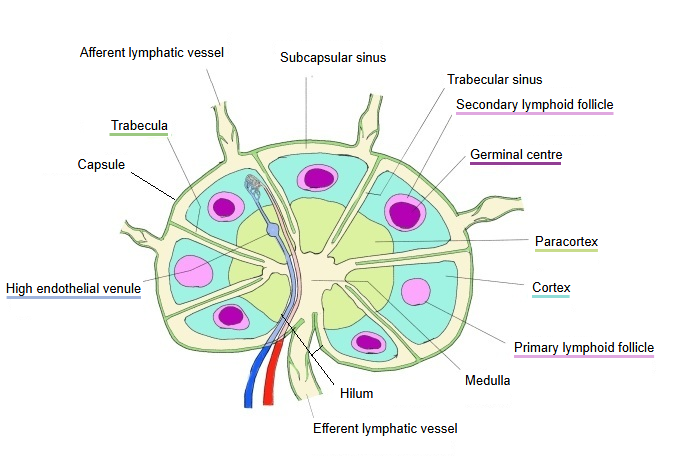
· Nerves: enter. Artery: enters. Vein: leaves. Efferent lymphatic vessels: leave.
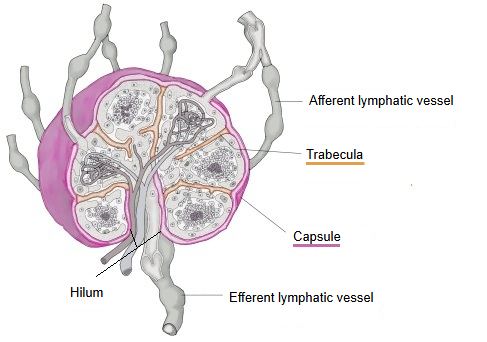
· The hilum itself is formed where the capsule of the node continues inwards, so the vessels and nerves pierce the capsule at the hilum; connective tissue from the hilum extends into the medulla.
In general, a hilum (hilus) is the place on an organ where vessels, nerves and ducts enter and leave, as in the splenic hilum, the hilum of the lung (with the root of the lung), the hilum of the kidney or the porta hepatis of the liver.
Flow of lymph
1. 1. The afferent lymphatic vessels enter the lymph node on its convex side, through the capsule; they do not use the hilum.
2. 2. The lymph flows through the node in the order subcapsular sinus → trabecular (cortical) sinuses → medullary sinuses.
3. 3. Several medullary sinuses join to form the efferent lymphatic vessels, which leave the node at the hilum.
Flow of lymph in a lymph node
Related terms
References and sources
- Further reading: Lymph node, Wikipedia.
- Further reading: Hilum (anatomy), Wikipedia.
- Federative International Programme for Anatomical Terminology (FIPAT). Terminologia Anatomica, 2nd ed. (TA2), 2019.