Internal root sheath (Latin: Vagina epithelialis radicularis interna)
Also called the inner root sheath
· The internal and external root sheaths begin below the opening of the duct of the sebaceous gland.
- Epidermic hair follicle : continuation of the epidermis
- Internal root sheath
- Sheath cuticle : flattened keratinized cells overlapping like roof tiles, interlocking with the hair cuticle
- Huxley's layer : one to three layers of cuboidal cells, most with nuclei, containing trichohyalin granules
- Henle's layer : a single layer of flat, keratinized cells without nuclei
- External root sheath : direct continuation of the germinative layers of the epidermis; a non-keratinizing stratified epithelium with clear cell bridges
- Stratum spinosum (inner)
- Stratum basale (outer)
- Internal root sheath
- Dermic hair follicle : continuation of the dermis
- Glassy membrane : two structureless membranes on the inner surface; the inner is the epithelial basement membrane, the outer belongs to the connective tissue
- Inner circular layer : circular connective tissue (collagen and elastic fibres) with capillaries
- Outer longitudinal layer : longitudinal connective tissue (collagen and elastic fibres) with capillaries, myelinated nerve fibres and fat
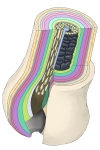 Hair follicle (cut-away view)
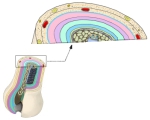 Hair follicle (cross section)
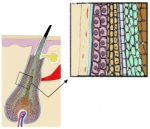 Hair follicle layers (longitudinal section)
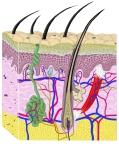 Skin and hair follicle
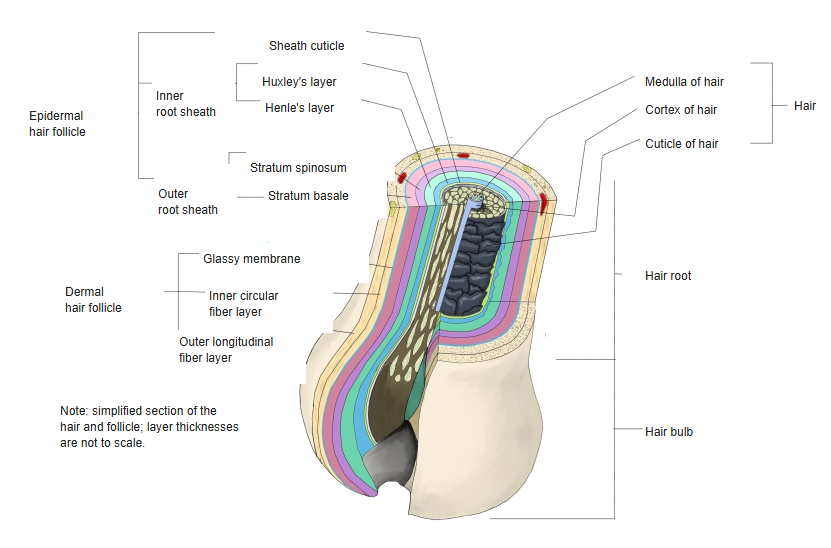
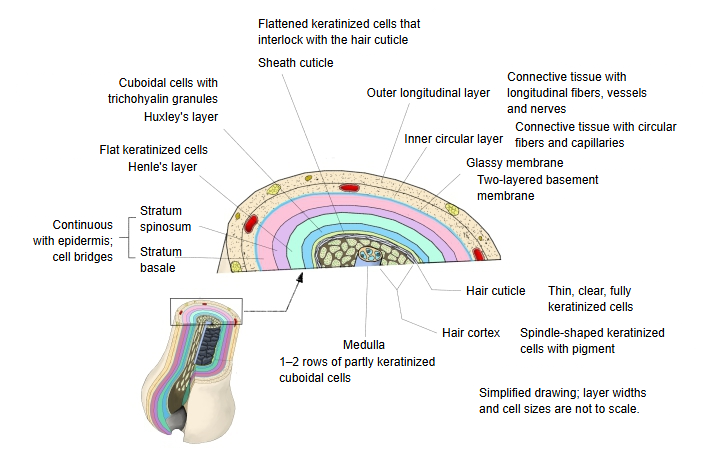
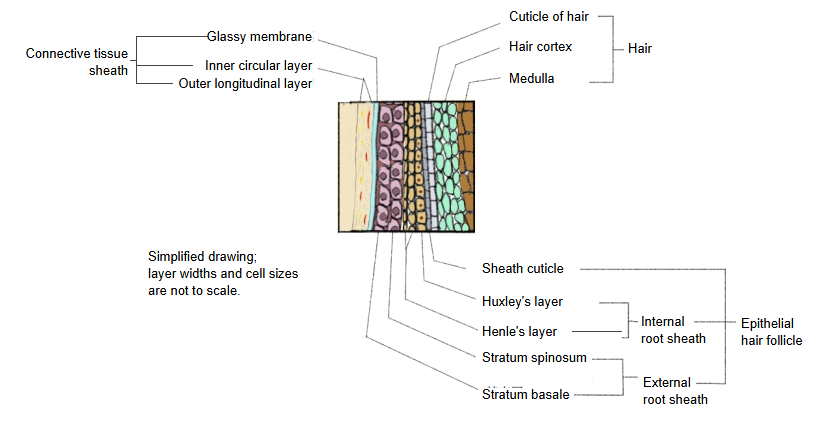
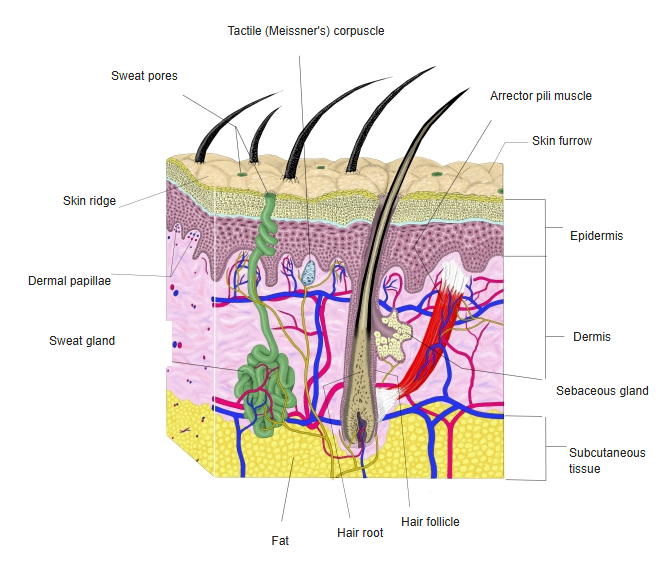
The internal root sheath is the inner epithelial layer of the hair follicle. It lies directly around the hair root, between the hair inside and the external root sheath outside; together the two sheaths form the epithelial part of the hair follicle. It is often compared with the granular and clear layers of the epidermis: its cells keratinize, but more softly than the hair itself. It has three layers. The outer, Henle's layer, is one row of flat, keratinized cells without nuclei, next to the external root sheath. The middle, Huxley's layer, is one to a few rows of mostly nucleated, roughly cuboidal cells containing trichohyalin granules. The inner, the cuticle of the internal root sheath, is made of flat, overlapping cells that interlock with the hair cuticle and anchor the hair in the follicle. Higher up the layers keratinize fully and can no longer be told apart. Some texts count only two layers (Henle's and Huxley's) and treat the sheath cuticle separately; sources differ. The sheath grows up from the hair bulb together with the hair and holds and shapes the growing hair; it breaks down at about the level of the sebaceous gland duct, so the hair leaves the follicle without it.
Reference websites
[Wikipedia]
· Inner root sheath, Wikipedia.
· Hair follicle, Wikipedia.
Related terms
References and sources
- Further reading: Hair follicle, Wikipedia.
- Further reading: Inner root sheath, Wikipedia.
- Federative International Programme for Anatomical Terminology (FIPAT). Terminologia Anatomica, 2nd ed. (TA2), 2019.