Lactiferous sinus (Latin: sinus lactifer)
Also called Ampulla of lactiferous duct
· During breastfeeding this part widens and holds milk, which the infant's sucking presses out.
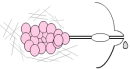 Lobe of the mammary gland (model 1)
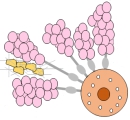 Lobes of the mammary gland (model 2)
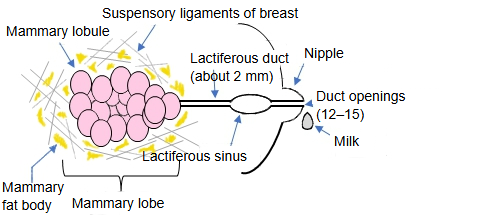
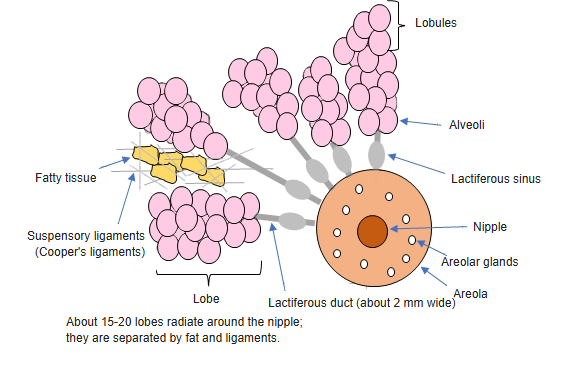
Each lactiferous duct has one sinus, a spindle-shaped widening about 5–7 mm across, lying beneath the areola just before the duct enters the nipple. Beyond the sinus the duct narrows again and opens on the tip of the nipple (openings of the lactiferous ducts). During breastfeeding the sinus can widen and hold a little milk, which the infant's sucking presses out; this allows continuous sucking while the milk-ejection reflex lasts. Sources differ: ultrasound studies of breastfeeding women often show no permanent storage sinus, only ducts that widen briefly during milk ejection.
Reference websites
[Wikipedia]
· Lactiferous duct, Wikipedia.
· Mammary gland, Wikipedia.
[Websites with illustrations]
· Mammary gland (Encyclopaedia Britannica)

· Breast anatomy (figure) (AMBOSS)

Related terms
- Lactiferous duct
- Openings of lactiferous ducts
- Lobes of mammary gland
- Body of breast
- Intermammary cleft
- Breast
- Mammary gland
- Accessory breast
- Lateral mammary branches
References and sources
- Further reading: Lactiferous duct, Wikipedia.
- Further reading: Mammary gland, Wikipedia.
- Federative International Programme for Anatomical Terminology (FIPAT). Terminologia Anatomica, 2nd ed. (TA2), 2019.