Latin: musculus iliopsoas
Overview
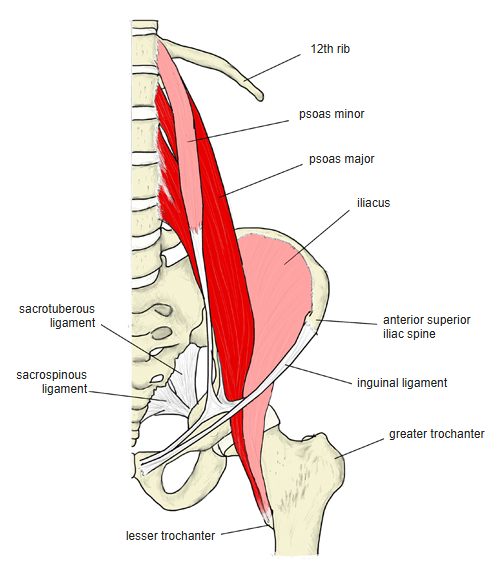
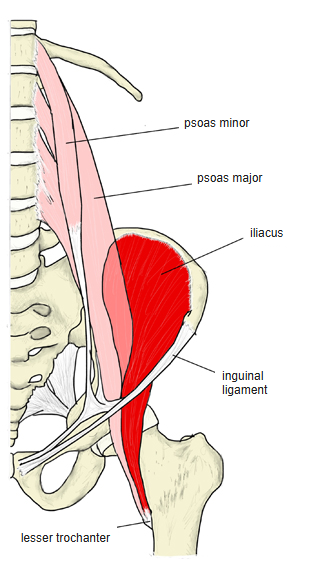
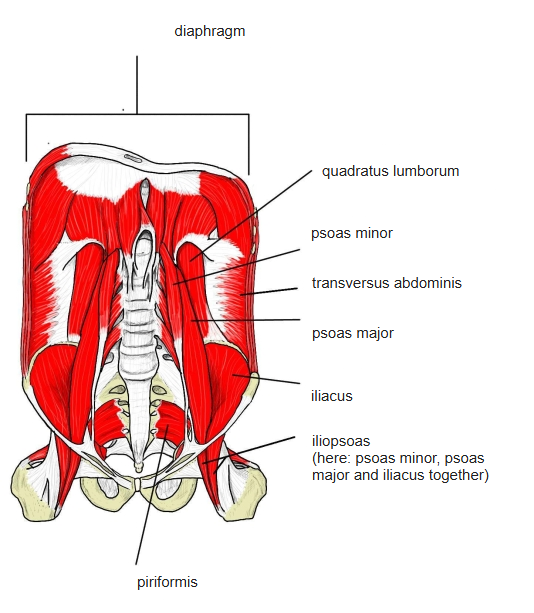
- A collective name for the psoas major and the iliacus; some texts, including the classification used on this site, also include the psoas minor. They belong to the inner hip muscles.
- A deep ("inner") muscle linking the lumbar spine, the pelvis and the femur.
- Its action is essentially that of the psoas major and the iliacus; the psoas minor is absent in about half of people and, when present, is very thin.
- See the individual muscle pages for their origins, insertions, innervation and blood supply.
Illustrations
Origin / insertion
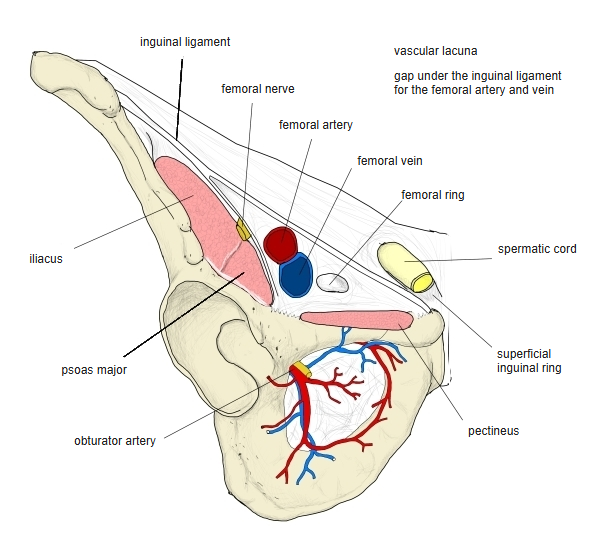
- Origin: bodies of T12–L5 and transverse processes of the lumbar vertebrae (psoas major), bodies of T12 and L1 (psoas minor) and the iliac fossa (iliacus)
- Insertion: lesser trochanter of the femur (common tendon of the psoas major and iliacus); the psoas minor ends on the pectineal line and iliopubic eminence
Action
- Flexes the hip
- Laterally rotates the hip
- Tilts the pelvis forward
Innervation
- Branches of the lumbar plexus (psoas major) and the femoral nerve (iliacus); see their pages
Blood supply
- See the psoas major and iliacus pages
Related terms
- Psoas major
- Psoas minor
- Iliacus
- Lesser trochanter
- Lumbar plexus
References and sources
- Further reading: Iliopsoas, Wikipedia.