Latin: musculus semispinalis capitis
Overview
- The upper part of the semispinalis (capitis, cervicis, thoracis).
- Lies completely under the splenius muscles, medial to the longissimus cervicis and capitis.
- Complex pennate; divided into a narrow medial and a fibrous lateral bundle, both with an intermediate tendon.
- Largely formed from the lateral group of the intrinsic back muscles, so it is supplied by both medial and lateral branches of the dorsal rami.
- Can be felt as a firm round mass just lateral to the cervical spinous processes (Wikipedia).
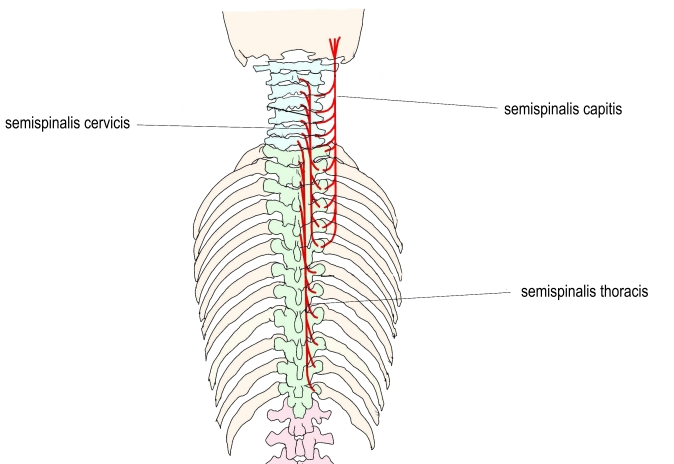
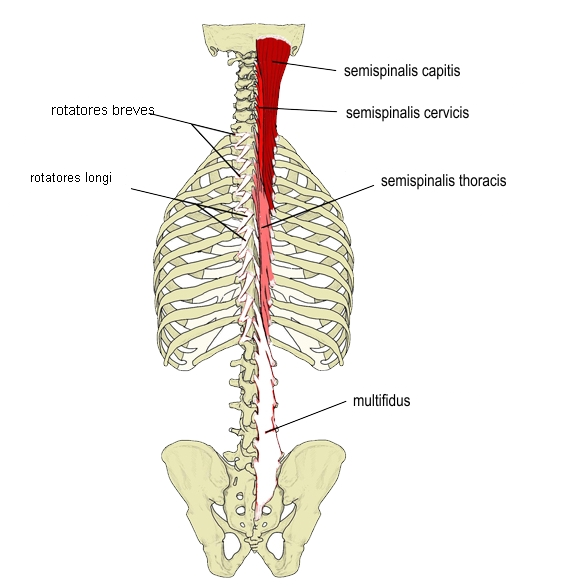
Position in the classification
Trunk › Back › Deep back muscles › Second layer › Intrinsic back muscles › Transversospinalis
- Semispinalis thoracis
- Semispinalis cervicis
- Semispinalis capitis
- Multifidus
- Rotatores breves
- Rotatores longi
Origin / insertion
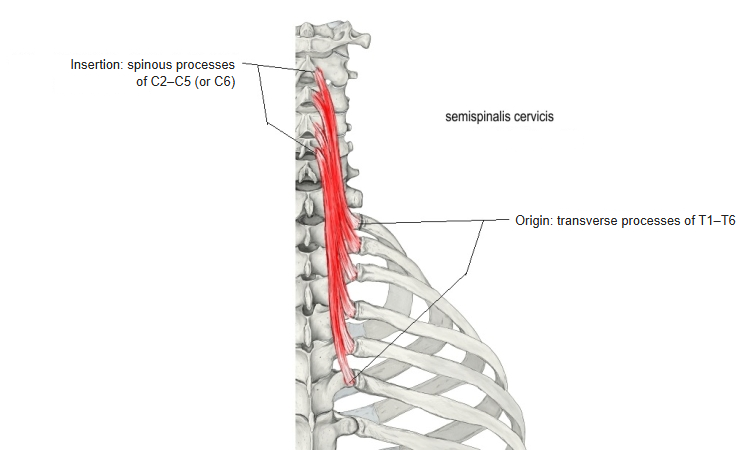
- Origin: transverse processes of the upper six thoracic vertebrae (and C7) and the articular processes of C4–C6
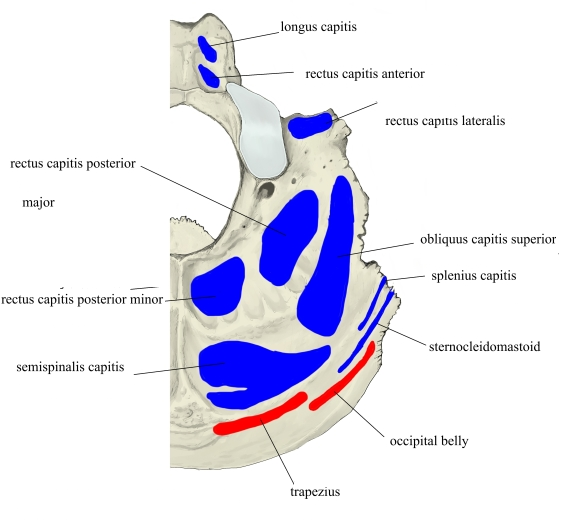
- Insertion: occipital bone between the superior and inferior nuchal lines
Action
- Extends and laterally bends the spine and head
- The semispinalis as a whole: bends the spine back and, on one side, turns it to the other side
Innervation
- Dorsal rami of the cervical nerves (C1–C6, not certain); medial and lateral branches
Blood supply
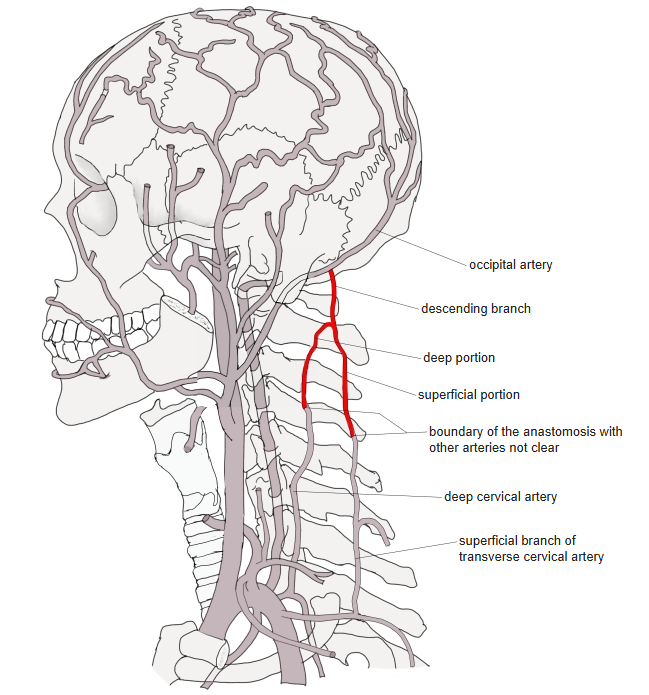
- Muscular branches of the posterior intercostal arteries, descending branch of the occipital artery, deep cervical branch of the costocervical trunk
Related terms
- Semispinalis cervicis
- Semispinalis thoracis
- Splenius capitis
- Longissimus capitis
- Occipital bone
References and sources
- Further reading: Semispinalis muscles, Wikipedia.