Parasympathetic nerve fibers (Latin: neurofibrae parasympathicae)
Also called Parasympathetic fibres
Parasympathetic nerve fibres are the nerve fibres that make up the parasympathetic nervous system; they can be divided into preganglionic fibres and postganglionic fibres.
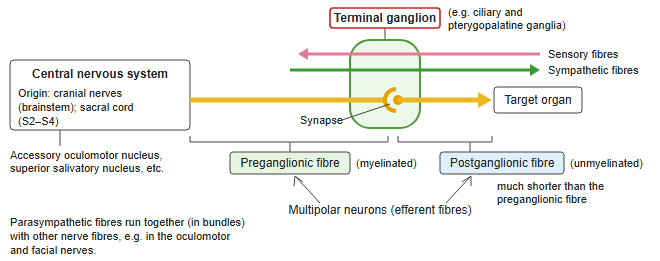
One of the two parts of the autonomic nervous system. The fibres start from nuclei in the brainstem (travelling with the oculomotor, facial, glossopharyngeal and vagus nerves) and from the sacral spinal cord (S2–S4, through the pelvic splanchnic nerves)
Parasympathetic nerve fibres are the axons of multipolar neurons; there are two kinds, myelinated and unmyelinated fibres.
The same as in the sympathetic nerve fibresA myelin sheath covers the axon, so signals travel faster
· The preganglionic fibres are myelinated, and the postganglionic fibres unmyelinated.
Parasympathetic nerve fibres synapse in a ganglion close to (or within the wall of) the target organ, so the preganglionic fibres are long and the postganglionic fibres very short.
Some of these ganglia have their own names; the others are known by a general name
· Ganglia with their own names: the ciliary ganglion, the pterygopalatine ganglion, the submandibular ganglion and the otic ganglion.
· General name: terminal (intramural) ganglia, the many small ganglia in or near the walls of the organs.
Related terms
- Parasympathetic nerves
- Preganglionic fiber
- Postganglionic fiber
- Parasympathetic ganglion
- Autonomic nervous system
- Ciliary ganglion
- Pelvic splanchnic nerves
References and sources
- Further reading: Parasympathetic nervous system, Wikipedia.
- Federative International Programme for Anatomical Terminology (FIPAT). Terminologia Anatomica, 2nd ed. (TA2), 2019.