Nerve fibre (Latin: neurofibra)
Also called the nerve fiber
· Axon (with the tissues that belong to it)
· Axon (as above) + the peripheral process of a pseudounipolar neuron
Axon only (with the tissues that belong to it)
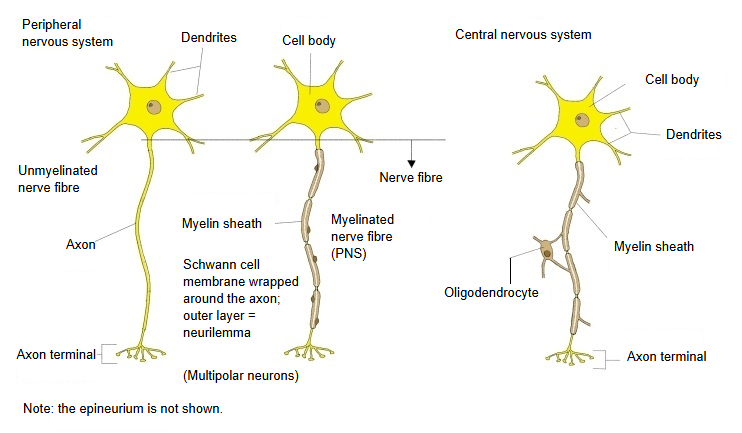
The axon is the process that grows out of the cell body and carries signals away from it. The tissues around it are:
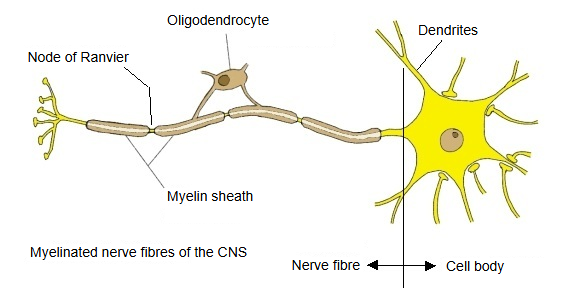
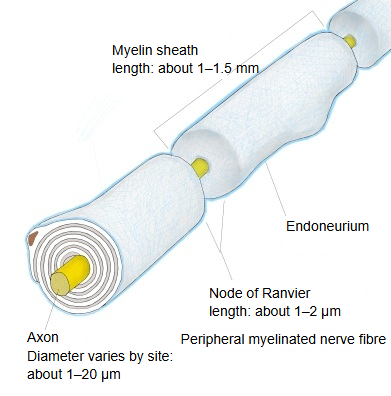
1. Myelin sheath: formed by oligodendrocytes (in the central nervous system) and Schwann cells (in the peripheral nervous system) wrapping around the axon.
2. Sheaths of a peripheral fibre: each fibre is enclosed by its Schwann cell sheath (neurilemma) and, outside it, by the endoneurium, a delicate connective-tissue layer. Bundles of fibres are wrapped by the perineurium and the whole nerve by the epineurium.
fibres
- Central nervous system
- Myelinated : axon + myelin sheath formed by an oligodendrocyte
- Unmyelinated : axon only
- Peripheral nervous system
- Myelinated : axon + myelin sheath formed by a Schwann cell + endoneurium
- Unmyelinated : axon + Schwann cell sheath (no myelin) + endoneurium
 Myelinated nerve fibre (CNS)
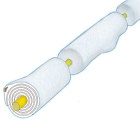 Myelinated nerve fibre (PNS, cross-section)
Axon + the peripheral process of a pseudounipolar neuron
In a pseudounipolar neuron a single process leaves the cell body and soon divides in two: one branch is the peripheral process, the other the central process. The central process is an axon. The peripheral process is often called a "dendrite", but in function it is an axon that conducts action potentials.
When this peripheral process receives sensory information from the skin of the fingertips or toes, it is very long: it runs all the way to the spinal ganglion (dorsal root ganglion) where the cell body lies, at least about 60 cm and in the longest cases 1 m or more.
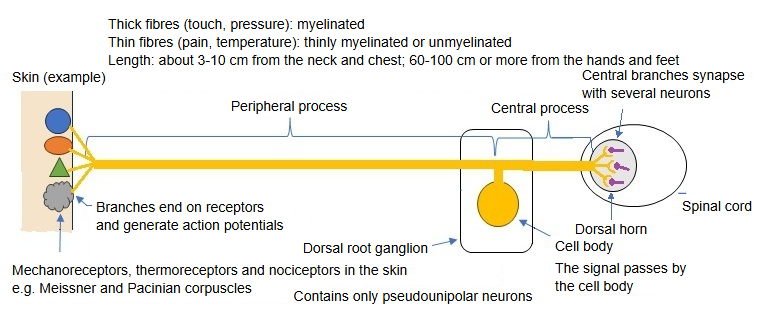
In this wider sense, any long process that leaves a nerve cell body, whether axon or dendrite, is called a nerve fibre, and the long dendrites (peripheral processes) of peripheral sensory nerves are nerve fibres too. Nerve fibres are divided into four kinds by whether they have a Schwann cell sheath and a myelin sheath; the process inside these sheaths is called the axon.
| Kind | Schwann cell sheath | Myelin sheath | Structure and examples | |
|---|---|---|---|---|
| 1 | Myelinated, with Schwann cell sheath | ● | ● | The peripheral myelinated fibres: the axon is wrapped by Schwann cells, each forming one segment of myelin. With nodes of Ranvier between the segments, impulses jump from node to node (saltatory conduction) and travel fast. Examples: motor fibres, thick sensory fibres. |
| 2 | Unmyelinated, with Schwann cell sheath | ● | × | The peripheral unmyelinated fibres: several axons share one Schwann cell, but no myelin is formed; conduction is slow. Examples: most postganglionic autonomic (sympathetic and parasympathetic) fibres, thin pain fibres. |
| 3 | Unmyelinated, without any sheath | × | × | Unmyelinated fibres of the central nervous system: no myelin from oligodendrocytes either; thin, almost bare axons lying among glial processes. Example: some short connecting fibres in the brain and spinal cord. |
| 4 | Myelinated, without Schwann cell sheath | × | ● | Myelinated fibres of the central nervous system: oligodendrocytes form the myelin and there are no Schwann cells. Example: the myelinated fibres of the brain and spinal cord. |
Myelin sheath = medullary sheath.
How long is the peripheral process of a sensory neuron?
The "dendrite" (peripheral process) of a peripheral sensory neuron ranges from a few centimetres to 1 m or more. Rough examples in an adult:
| Route | Length of the peripheral process | |
|---|---|---|
| 1 | Fingertip → spinal ganglion of the neck | roughly 0.6-1 m |
| 2 | Toe → lumbar or sacral spinal ganglion | about 1 m or more |
| 3 | Trunk | some tens of centimetres |
| 4 | Face (trigeminal nerve and others) | a few centimetres to over 10 cm |
These peripheral processes are among the longest processes in the body.
Why is it called a "dendrite"?
Because, like a dendrite, it carries impulses toward the cell body. In structure and function, however, it is an axon: it is often myelinated, generates action potentials and conducts them over long distances.
Related terms
- Axon
- Dendrite
- Endoneurium
- Perineurium
- Nerve sheath
- Unmyelinated nerve fibre
- Node of Ranvier
- Peripheral process
- Axon terminal
- Glial cell
- Afferent nerve fibers
- Nervous tissue
References and sources
- Further reading: Nerve fiber, Wikipedia.
- Further reading: Axon, Wikipedia.
- Federative International Programme for Anatomical Terminology (FIPAT). Terminologia Anatomica, 2nd ed. (TA2), 2019.