Pelvic inclination
Also called the inclination of the pelvis or the pelvic tilt
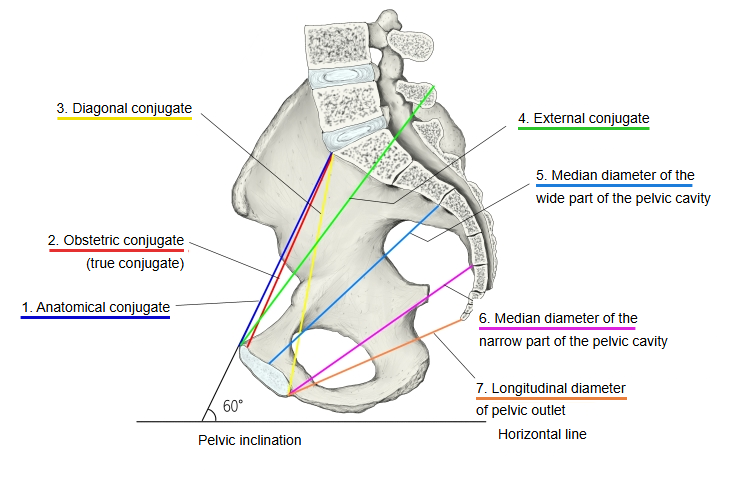
Pelvic inclination is the angle (about 60°) between the anatomical conjugate, from the sacral promontory to the upper edge of the pubic symphysis, and the horizontal plane. On the living body it can be estimated from the external conjugate: draw a right triangle whose hypotenuse is the external conjugate and one of whose sides is the difference in height between its back end (the lumbar point, below the spine of the last lumbar vertebra) and its front end at the symphysis; the angle between the third side and the hypotenuse gives the inclination.
It is also defined as the angle that the plane of the superior pelvic aperture (pelvic inlet) makes with the horizontal plane when a person stands upright.
Sources give values of roughly 50 to 65° in the standing adult, usually a little larger in women. Because of this tilt the pelvic inlet faces forwards as well as upwards, and the weight of the trunk passes to the hip joints in front of the sacrum. The angle changes with posture: it increases with a stronger lumbar curve (lordosis) and decreases when the pelvis is tilted backwards.
Related terms
- Symphysis
- Pelvis
- Superior pelvic aperture
- Anatomical conjugate
- Median diameter (pelvis)
- Promontory (sacrum)
- Pubic symphysis
- Lesser pelvis
References and sources
- Further reading: Pelvic tilt, Wikipedia.
- Further reading: Pelvic inlet, Wikipedia.
- Federative International Programme for Anatomical Terminology (FIPAT). Terminologia Anatomica, 2nd ed. (TA2), 2019.